Tuesday, July 24, 2012

My Amazing Illegal Outpost Adventure: Ariel and Barkan

Yom shlishi, 5 Av 5772.

If you haven't read Part One of this tour, and feel the need, please click here.

After we left Kedumim, we started driving toward Ariel.  Ariel, a city of more than 17,000 residents, has been in the news a lot lately, due to a boycott of its Center for the Performing Arts by actors who -- I'm sorry to say -- didn't do their homework before jumping like lemmings off the "Israel has to be in the wrong" cliff, and because of the university there that has been trying to get status as an official university of Israel.  Fierce opposition to the request has been launched by parties on the Left who assume that we Jews have no right to live in the West Bank.  And so it goes... 


Ariel, the capitol of the Shomron, is a lovely little city that has been in existence since 1978.  I think it's important to remember, as we listen to the skewed "news" stories about the Middle East, that not all of the so-called illegal settlements are tiny groups of caravans.  (Even that shouldn't be an issue, according to a correct reading of international law; but we'll get to that later.)  The MSM (mainstream media) like to present these communities as if they are temporary, hastily-thrown-together encroachments on territory that rightfully belongs to Arabs.  Rather, the West Bank -- which is more honestly called Yehuda and Shomron -- is filled with Arab cities and villages, and Jewish cities and villages.  With lots of open spaces in between.


And for those who still persist in believing news accounts that seem to indicate that settlers are willfully putting up these "villages" without Israeli government support, remind them that even Israelis cannot cause electricity, plumbing and sewage to sprout out of the ground without a little help from their friends.


Ariel's university has, according to YNet, 13,000 students, including 5% Arab students and a large number of Ethiopian Jewish students.  I am sure they are all grateful that that their degrees will be obtained by an official university -- as this status was finally obtained a few days after our tour. (We didn't have anything to do with the final outcome, other than being really happy for Ariel and all concerned.)

We're talking serious infrastructure here.


We had lunch in the sweet little park pictured above.  The park, like most of the parks we have seen in Shomron and Yehuda, reminds us that children are the most important commodity of the settlement enterprise.

As the Dearly Beloved says, the best part of any tour is the people we meet.  We were blessed to meet several lovely couples, among them the Franks, with whom we shared lunch and conversation.   They are new olim, 85 and 81 years old, who live in French Hill in Jerusalem.  "I just told him it was time to make aliyah," said Lore Frank.  "So I came," finished Shimon Frank.  Lore (pronounced "Lori") was very proud to let us know that Shimon had been here before.  "He fought with the navy in the War of Independence in 1948," she told us.  They inspired us in so many ways, and we hope to keep in touch.


A pillbox guard post -- sometimes called a "fillbux" or a "pillibox" by Israelis -- is a constant reminder that the IDF must keep its eyes and ears on the areas surrounding these yishuvim at all times.

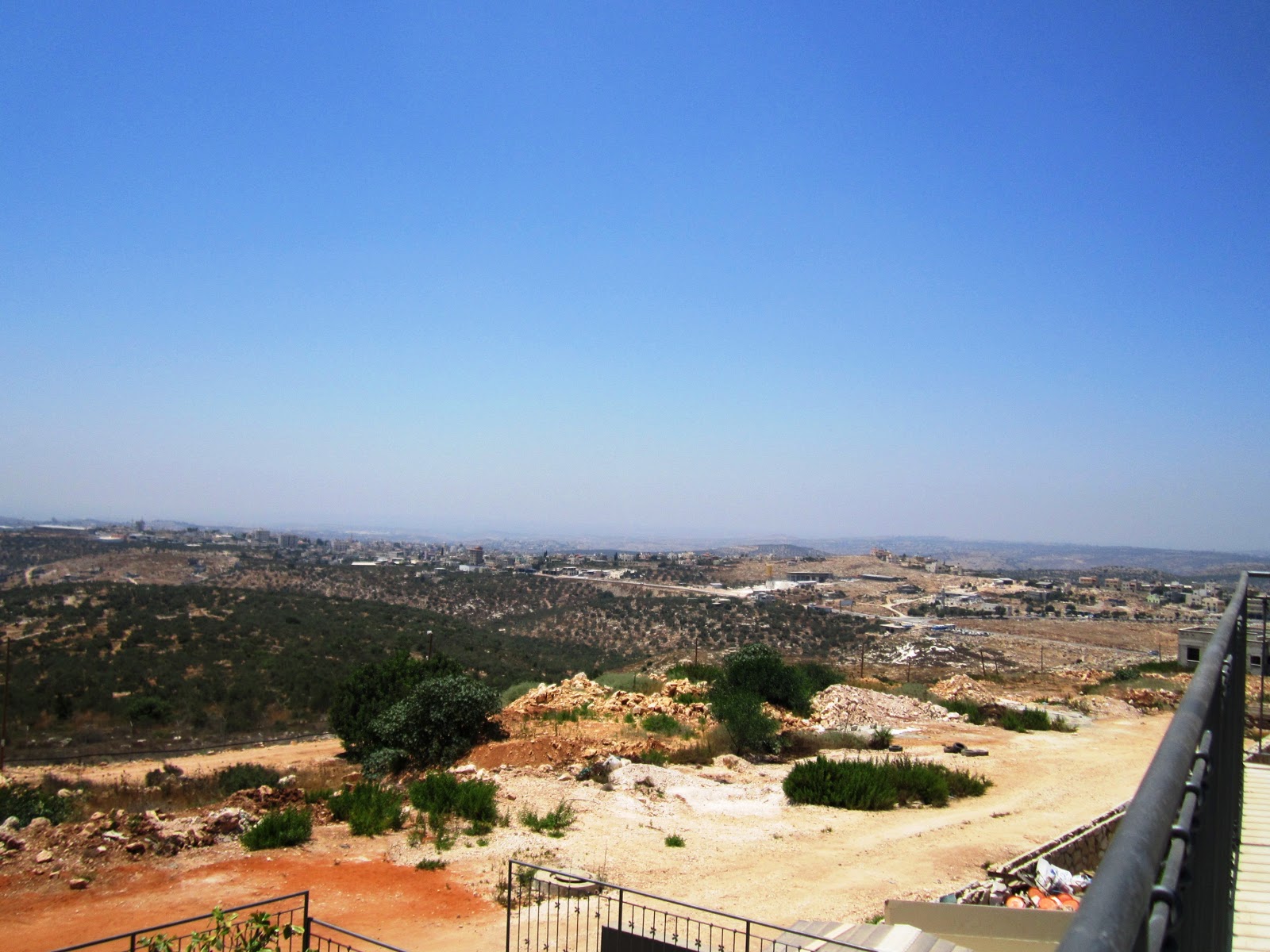
The view of the area surrounding Eynavis

Hard to imagine why people think there isn't room for all kinds of settlement...


After lunch, we packed up for the trip to Barkan, a very small yishuv, where the sweet and funny owner of the Eynavis boutique and chocolate workshop, Sharon Kahane, taught us how to make chocolate -- and insisted disarmingly that we teach her to speak English.

The process is quite detailed.  When she was finished, we understood why handmade chocolate isn't cheap!


Eve Harow, our tour guide, explained to us how the international boycott of products from Yehuda and Shomron is affecting both Israelis and Palestinians -- and, in fact, Palestinians more than Israelis.  While Eynavis is an exception, many companies have moved their businesses to Tel Aviv and other areas within the Green Line, to avoid the boycott.  So while the Jewish businessman might be temporarily inconvenienced, his business can continue to thrive.  However, if he hired Palestinian laborers, they are simply out of a job.  I wonder if the organizations that work so hard to punish Israel for being Jewish to help the downtrodden actually think this through?

Stay tuned for the third and final part of our adventure: a visit to Psagot for wine, and to much-maligned Migron.  The plot thickens...

Sunday, July 22, 2012

My Amazing Illegal Outpost Adventure: Kedumim


Yom rishon, 3 Av 5772.

Now that I have your attention, I will say that I considered putting quotation marks around the word "illegal" in the title because in relation to Israel,  the word has been abused to the point of being rendered nearly meaningless.  Suffice it to say that there are millions of misguided people who think that one Jew in all of the so-called West Bank is two too many.  More on that later.

This adventure was so full of things to learn and people worth knowing, it will take more than one post.  Stick with me.  This tiny country is so full of wonderful and important stories!

A week ago, the Dearly Beloved and I went on a tour of the Shomron (Samaria, aka the northern part of the "West Bank") with Eve Harow, under the auspices of the OU Center in Jerusalem.  Eve is a knowledgeable and entertaining tour guide who uses the Tanach as a guidebook.  It is deeply satisfying to travel the Holy Land of Israel while being shown the locations where great Biblical events actually took place.

Our first stop was Kedumim, a 27-year-old town of approximately 3,500 residents whose primary industry is education.   We met first with Michael Osnis, who told us a remarkable story of how he came to build a model of the Second Holy Temple.

Michael's story is nothing short of amazing.  He told us that he was a secular Jew from the former Soviet Union, with no knowledge of the Torah or the Holy Temple, and with no belief in G-d.

He was invited to Kfar Chabad for Shabbat when he was a young oleh, and saw his host's children playing a card game.  As he looked closer, he saw that the cards had unusual symbols on them, not the usual hearts, spades, diamonds and clubs.  One picture in particular fascinated him, so he asked about it.  The children didn't understand how a grown man could not know about the Holy Temple, but they patiently explained to him.

A few weeks later, he had a powerful dream about the Temple.  He became obsessed with it. A master stonemason, he felt that he would not rest until he had built it, and with materials as authentic as possible.

He wanted it to be right, but he had no idea where to find answers, not yet knowing enough to go to the Mishnah for details.  He stumbled upon the works of Josephus Flavius, the commentator of the period of the Roman conquest of Jerusalem and the Holy Temple.  Michael read and re-read with fascination the detailed description in Josephus' writings about the Temple.  With guidance from his research and the Temple Institute in Jerusalem, he painstakingly constructed a model that was so accurate that Aish HaTorah commissioned a 1,200 kilogram version that was placed on top of a roof of one of their buildings overlooking the Kotel.


The sweetest part of the story is that Michael's obsession with his dream, and with learning about and building his model of the Second Temple, caused him the begin observing Judaism.  He went on to build a beautiful replica of the Mishkan as well.


Even the curtain for the front of the model of the Mishkan was woven in careful detail.

After this inspiring visit, we moved to the Kedem Museum, which was founded and is run by Zvi (Zvika) Slonim, winner of this year's Moskowitz Prize for Zionism.  Unfortunately, the museum is going through renovations; so we were unable to learn anything about it.  (A good reason for a return visit.)

To quote the Moskowitz site, "The Moskowitz Prize for Zionism was established in recognition of the people who put Zionism into action in today’s Israeli society – at times risking their own personal security, placing the collective before personal needs, and doing what it takes to ensure a strong, secure Jewish homeland."


A seventh-generation Israeli, Zvi Slonim is a direct descendant of the Alter Rebbe of Lubavitch, and the grandson of the chief rabbi of Hevron at the time of the 1929 pogrom.  He is also a criminologist, and an expert on juvenile delinquency and special education.  What motivated him to leave a fulfilling career and work so tirelessly to fill the Land with Jews?  He quotes Mesilat Yesharim (The Path of the Just):  "What is man's obligation in this world?"

One night, he heard Egyptian president Anwar Sadat say that he would be willing to sacrifice a million soldiers for a tiny speck of the land of Israel.  Hearing this impressed upon Zvi how important must be the Land to the Jews.  He felt that our Torah teaches us that we must love the Land, and that we must fill it up and live in it.  He hoped that he could bring a hundred Jews with him.  He became one of the founders of the Gush Emunim movement, and one of the first settlers in the Shomron.  It was important to him that his organization purchase every speck of land legally, without violence, without a hint of stealing the land, so that no one could question the legality of the Jewish ownership of the settlements.  He proceeded to help to establish 148 settlements with a half a million people.

To be continued.  Next stops:   Barkan for handmade chocolate, and Ariel, home to Israel's eighth university.


Photos taken by Ruti and Avi Eastman

Thursday, July 19, 2012

Hashke's Flowers

Yom chamishi, 29 Tamuz 5772.

"You know how it is, son.  You're a writer, too.  When the muse isn't there, no words come out."
"I know, Ema.  But I miss the flowers."

This post is for you, Soldier Boy.


These photos are from a walk I took in my beloved village, Neve Daniel, in June.  So by now, the figs and grapes and pomegranates are bigger, and the hot July sun is filling them up with juice.

One of the things I love about my neighbors is their appreciation for the Seven Species of the Land of Israel .


Here are your flowers, my son.  Surrounded by fruit trees and beautiful gardens.


Difficult to see clearly -- but it's a lemon tree.  Very pretty.  ;-)

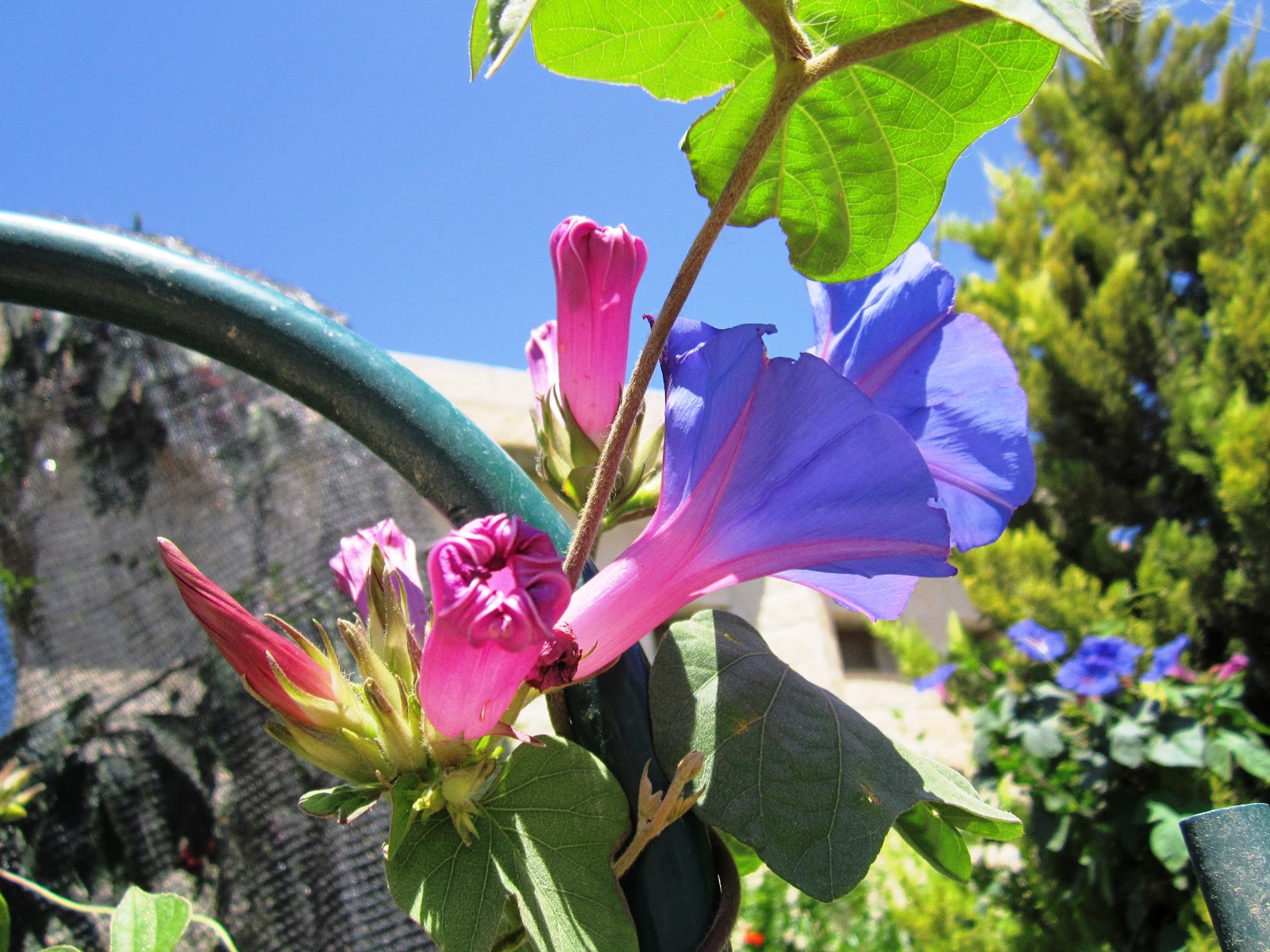
My favorite flower, the Passiaflora, looks like something from space.  This and the platypus show G-d's sense of humor.


A quiet tribute to the five young Israeli tourists murdered yesterday in Bulgaria.  May Hashem avenge their bloods.


The view of Beitar and the Judean Hills from my street.  On a clear day, you can see the Mediterranean Sea!
Looking forward to walking about Israel with you again one day soon, dear son!


Glossary:
Hashke: a Yiddish nickname for Yehoshua (Joshua in English)

Tuesday, July 17, 2012

"What is the Jew?"

Yom shlishi, 27 Tamuz 5772.

The hot summer, involvement in hasbara (Israeli public diplomacy), and simple contentment with life, have kept me from writing much lately.  Fortunately, the hot summer seems to inspire Yeshiva Bochur, aka Exiled Warrior, to write about his experiences in the IDF.  Here is an especially sweet post.  If you enjoy this piece, you may want to peruse some of his other recent writing at his blog.


We all looked up surprised when a bus full of young children pulled into our base on the Israel-Lebanon border. We were working on our equipment as they poured off the bus with huge smiles and eyes filled with wonderment. A smile soon crossed every tired soldier’s face as the kids ran around firing questions faster than some of the machine guns that were present.


It soon became understood that the children were those who had lost family members in war and or terror attacks. The sergeant called for a break from work and gathered everyone into one big room.

Usually this particular room is used for briefings before patrols on the border, but today it became filled with soldiers and children, or more appropriately, younger siblings and older brothers.


The kids donned with pride the red berets of the soldiers, and listened intently as they explained about the different types of guns and equipment.

All the kids had prepared letters which they handed out to the soldiers.

Mine was written by two young girls named Talia and Mashi. This is what they wrote:


Dear Soldier,

Shalom, our names are Talia and Mashi. We are campers in the summer camp "Mishpacha Echat." A camp for people whose families have been effected from war or terror. 

Both of our families have all been effected from terror. 

I (Talia), my older brothers, Lidor and Oriah, were killed on a bus in Jerusalem on a way to a family event. My father was injured slightly from the attack and my mother was not injured. My uncle, his wife and two kids were also killed in the attack. 

It is hard for me to be without my older brothers. 

I (Mashi), my father was killed in a shooting in the North. He was already let off his work before because of an injury from another terror attack. After the first attack he became a driver. He was taking people to work when he was killed. 

My father was killed when I was a year and two months. To be without a father is very hard. 

Thank you for guarding us, look out for yourselves.

We love you.


Talia and Mashi


These are the heroes I had the pleasure to be around today. This amazing camp, "Mishpacha Echat" brings these children here and they strengthen us and we strengthen them. The nation is strengthened. "The Nation builds the army, the army builds the Nation." That is the army's mantra.

Mark Twain, after studying the "The Jew," became perplexed and remarked: "All things are mortal but the Jew; all other forces pass, but he remains. What is the secret of his immortality?"

Our enemies have tried to destroy us time and again. They believe that they, like a mighty wave, will be able to extinguish the Jewish flame. But they, like all their predecessors, sink back into the sea, forgotten. The Jew however, is still standing. You have killed my older brothers, my father, my uncle, my nieces and nephews. But you have killed only their bodies. Their souls are eternal, we are eternal.

I am so proud of my Nation. When I see those bright-eyed kids that the enemy tried to destroy, wearing paratroopers’ red berets, I am reassured that we will never be defeated. We stand together, as One Family -- as a " Mishpacha Echat."

That Mr. Twain -- that is our secret.