Showing posts with label West Bank. Show all posts

Tuesday, July 24, 2012

My Amazing Illegal Outpost Adventure: Ariel and Barkan

Yom shlishi, 5 Av 5772.

If you haven't read Part One of this tour, and feel the need, please click here.

After we left Kedumim, we started driving toward Ariel.  Ariel, a city of more than 17,000 residents, has been in the news a lot lately, due to a boycott of its Center for the Performing Arts by actors who -- I'm sorry to say -- didn't do their homework before jumping like lemmings off the "Israel has to be in the wrong" cliff, and because of the university there that has been trying to get status as an official university of Israel.  Fierce opposition to the request has been launched by parties on the Left who assume that we Jews have no right to live in the West Bank.  And so it goes... 


Ariel, the capitol of the Shomron, is a lovely little city that has been in existence since 1978.  I think it's important to remember, as we listen to the skewed "news" stories about the Middle East, that not all of the so-called illegal settlements are tiny groups of caravans.  (Even that shouldn't be an issue, according to a correct reading of international law; but we'll get to that later.)  The MSM (mainstream media) like to present these communities as if they are temporary, hastily-thrown-together encroachments on territory that rightfully belongs to Arabs.  Rather, the West Bank -- which is more honestly called Yehuda and Shomron -- is filled with Arab cities and villages, and Jewish cities and villages.  With lots of open spaces in between.


And for those who still persist in believing news accounts that seem to indicate that settlers are willfully putting up these "villages" without Israeli government support, remind them that even Israelis cannot cause electricity, plumbing and sewage to sprout out of the ground without a little help from their friends.


Ariel's university has, according to YNet, 13,000 students, including 5% Arab students and a large number of Ethiopian Jewish students.  I am sure they are all grateful that that their degrees will be obtained by an official university -- as this status was finally obtained a few days after our tour. (We didn't have anything to do with the final outcome, other than being really happy for Ariel and all concerned.)

We're talking serious infrastructure here.


We had lunch in the sweet little park pictured above.  The park, like most of the parks we have seen in Shomron and Yehuda, reminds us that children are the most important commodity of the settlement enterprise.

As the Dearly Beloved says, the best part of any tour is the people we meet.  We were blessed to meet several lovely couples, among them the Franks, with whom we shared lunch and conversation.   They are new olim, 85 and 81 years old, who live in French Hill in Jerusalem.  "I just told him it was time to make aliyah," said Lore Frank.  "So I came," finished Shimon Frank.  Lore (pronounced "Lori") was very proud to let us know that Shimon had been here before.  "He fought with the navy in the War of Independence in 1948," she told us.  They inspired us in so many ways, and we hope to keep in touch.


A pillbox guard post -- sometimes called a "fillbux" or a "pillibox" by Israelis -- is a constant reminder that the IDF must keep its eyes and ears on the areas surrounding these yishuvim at all times.

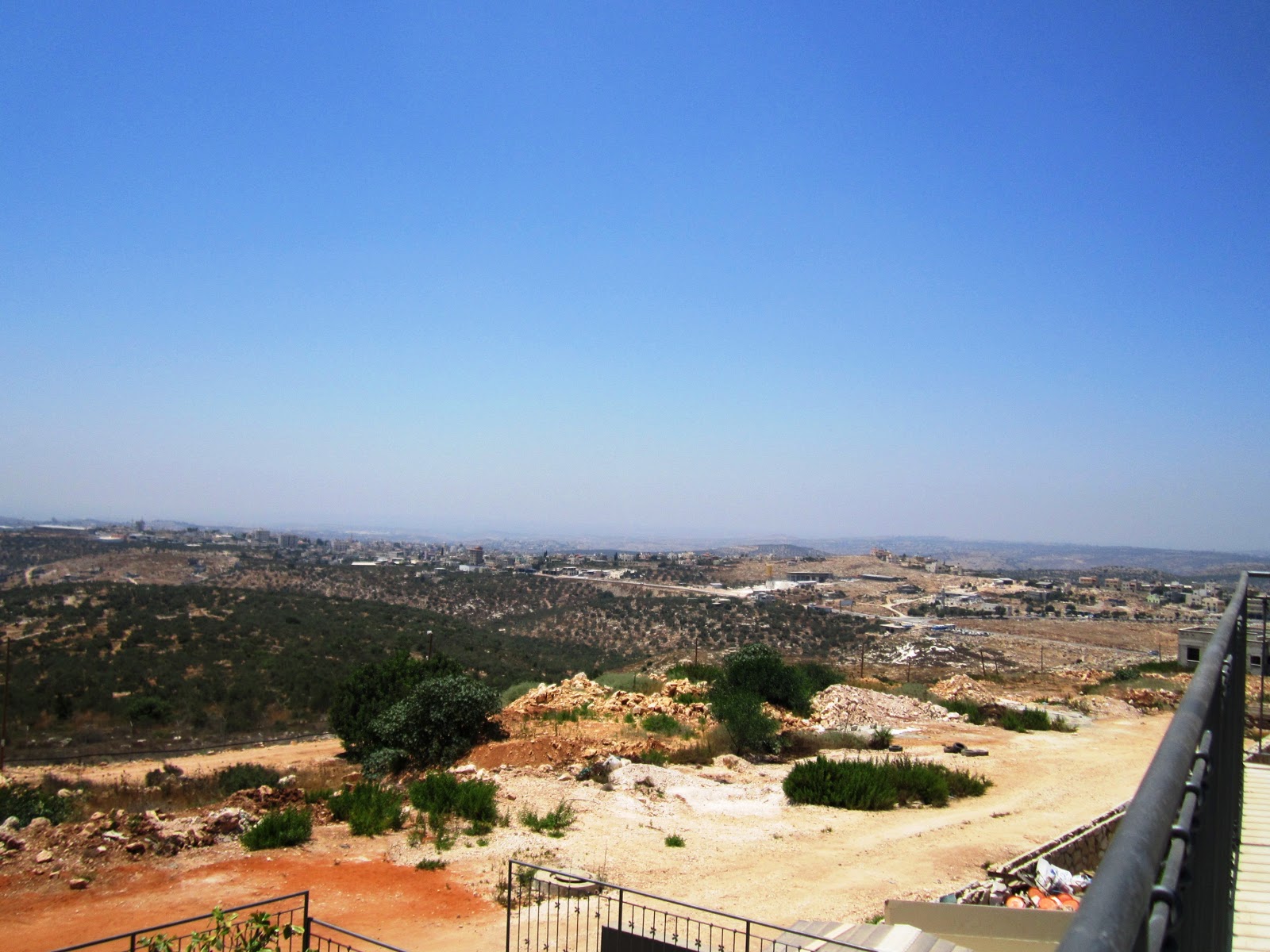
The view of the area surrounding Eynavis

Hard to imagine why people think there isn't room for all kinds of settlement...


After lunch, we packed up for the trip to Barkan, a very small yishuv, where the sweet and funny owner of the Eynavis boutique and chocolate workshop, Sharon Kahane, taught us how to make chocolate -- and insisted disarmingly that we teach her to speak English.

The process is quite detailed.  When she was finished, we understood why handmade chocolate isn't cheap!


Eve Harow, our tour guide, explained to us how the international boycott of products from Yehuda and Shomron is affecting both Israelis and Palestinians -- and, in fact, Palestinians more than Israelis.  While Eynavis is an exception, many companies have moved their businesses to Tel Aviv and other areas within the Green Line, to avoid the boycott.  So while the Jewish businessman might be temporarily inconvenienced, his business can continue to thrive.  However, if he hired Palestinian laborers, they are simply out of a job.  I wonder if the organizations that work so hard to punish Israel for being Jewish to help the downtrodden actually think this through?

Stay tuned for the third and final part of our adventure: a visit to Psagot for wine, and to much-maligned Migron.  The plot thickens...

Sunday, July 22, 2012

My Amazing Illegal Outpost Adventure: Kedumim


Yom rishon, 3 Av 5772.

Now that I have your attention, I will say that I considered putting quotation marks around the word "illegal" in the title because in relation to Israel,  the word has been abused to the point of being rendered nearly meaningless.  Suffice it to say that there are millions of misguided people who think that one Jew in all of the so-called West Bank is two too many.  More on that later.

This adventure was so full of things to learn and people worth knowing, it will take more than one post.  Stick with me.  This tiny country is so full of wonderful and important stories!

A week ago, the Dearly Beloved and I went on a tour of the Shomron (Samaria, aka the northern part of the "West Bank") with Eve Harow, under the auspices of the OU Center in Jerusalem.  Eve is a knowledgeable and entertaining tour guide who uses the Tanach as a guidebook.  It is deeply satisfying to travel the Holy Land of Israel while being shown the locations where great Biblical events actually took place.

Our first stop was Kedumim, a 27-year-old town of approximately 3,500 residents whose primary industry is education.   We met first with Michael Osnis, who told us a remarkable story of how he came to build a model of the Second Holy Temple.

Michael's story is nothing short of amazing.  He told us that he was a secular Jew from the former Soviet Union, with no knowledge of the Torah or the Holy Temple, and with no belief in G-d.

He was invited to Kfar Chabad for Shabbat when he was a young oleh, and saw his host's children playing a card game.  As he looked closer, he saw that the cards had unusual symbols on them, not the usual hearts, spades, diamonds and clubs.  One picture in particular fascinated him, so he asked about it.  The children didn't understand how a grown man could not know about the Holy Temple, but they patiently explained to him.

A few weeks later, he had a powerful dream about the Temple.  He became obsessed with it. A master stonemason, he felt that he would not rest until he had built it, and with materials as authentic as possible.

He wanted it to be right, but he had no idea where to find answers, not yet knowing enough to go to the Mishnah for details.  He stumbled upon the works of Josephus Flavius, the commentator of the period of the Roman conquest of Jerusalem and the Holy Temple.  Michael read and re-read with fascination the detailed description in Josephus' writings about the Temple.  With guidance from his research and the Temple Institute in Jerusalem, he painstakingly constructed a model that was so accurate that Aish HaTorah commissioned a 1,200 kilogram version that was placed on top of a roof of one of their buildings overlooking the Kotel.


The sweetest part of the story is that Michael's obsession with his dream, and with learning about and building his model of the Second Temple, caused him the begin observing Judaism.  He went on to build a beautiful replica of the Mishkan as well.


Even the curtain for the front of the model of the Mishkan was woven in careful detail.

After this inspiring visit, we moved to the Kedem Museum, which was founded and is run by Zvi (Zvika) Slonim, winner of this year's Moskowitz Prize for Zionism.  Unfortunately, the museum is going through renovations; so we were unable to learn anything about it.  (A good reason for a return visit.)

To quote the Moskowitz site, "The Moskowitz Prize for Zionism was established in recognition of the people who put Zionism into action in today’s Israeli society – at times risking their own personal security, placing the collective before personal needs, and doing what it takes to ensure a strong, secure Jewish homeland."


A seventh-generation Israeli, Zvi Slonim is a direct descendant of the Alter Rebbe of Lubavitch, and the grandson of the chief rabbi of Hevron at the time of the 1929 pogrom.  He is also a criminologist, and an expert on juvenile delinquency and special education.  What motivated him to leave a fulfilling career and work so tirelessly to fill the Land with Jews?  He quotes Mesilat Yesharim (The Path of the Just):  "What is man's obligation in this world?"

One night, he heard Egyptian president Anwar Sadat say that he would be willing to sacrifice a million soldiers for a tiny speck of the land of Israel.  Hearing this impressed upon Zvi how important must be the Land to the Jews.  He felt that our Torah teaches us that we must love the Land, and that we must fill it up and live in it.  He hoped that he could bring a hundred Jews with him.  He became one of the founders of the Gush Emunim movement, and one of the first settlers in the Shomron.  It was important to him that his organization purchase every speck of land legally, without violence, without a hint of stealing the land, so that no one could question the legality of the Jewish ownership of the settlements.  He proceeded to help to establish 148 settlements with a half a million people.

To be continued.  Next stops:   Barkan for handmade chocolate, and Ariel, home to Israel's eighth university.


Photos taken by Ruti and Avi Eastman

Sunday, May 22, 2011

"All of that was not our affair."

Yom rishon, 18 Iyar 5771, Lag B"Omer.

One of the beautiful communities of Gush Katif, before the "Disengagement"
 For friends and acquaintances in Karnei Shomron, Elon Morei, Beit El, Givat Ze'ev, Kochav Shachar, Kochav Ya'akov, Ofra, Shiloh, Eli, Almog, Hevron, Susiya, Otniel, Kiryat Arba, Karmei Tzur, Ma'ale Amos, Nokdim, Tekoa, Itamar (haven't they suffered enough???), I offer the following quote.

First they came for the communists,
and I didn't speak out because I wasn't a communist.


Then they came for the trade unionists,
and I didn't speak out because I wasn't a trade unionist.


Then they came for the Jews,
and I didn't speak out because I wasn't a Jew.


Then they came for me
and there was no one left to speak out for me.


Martin Niemöller (1892-1984)

Before the uprooting of the Gush Katif communities, I never would have thought I would need to employ Niemöller's quote for Jews about Jews.  But now, seeing my community on the list of those that will allegedly survive this proposed cut, I can only think that I must not be silent.  Because in the end, they will come for me.  And there will be no one left to speak for me.
destroyed "for peace," 2005
As far as I know, this list of potential sacrifices is still only at the level of rumor; and I sincerely hope that the events and speeches of recent days have reminded those in power that these communities must never be uprooted.  Especially for hollow promises.  The list is in Hebrew; so if this is not your strong language, read instead the language of numbers.  Each community's name is followed by its number of citizens.  "Citizens" means people like you and me, who go to work, who work the land, who send their kids to the best schools possible, who put on uniforms to defend their families from enemies, who want to live in peace and harmony with their neighbors.
Katif, destroyed "for peace," 2005
Please bear in mind that many of these communities are not "settlements" the way you and I envision settlements, because of the way the media like to portray them.  They are not shabby little tent villages, or clapboard construction, thrown up to "steal" land from harmless Palestinians.  They are communities that have existed in some cases for generations.  They have Biblical history.  Many were uninhabited when their present occupants nurtured them from barren sand.  Just like Gush Katif was.
Netzer Hazani, destroyed "for peace," 2005
We cannot know what is coming, dear fellow citizens of Eretz Yisrael.  But I want you to know that I will not look at you as expendable, for some illusion of safety and comfort.  As our Prime Minister told the American President yesterday:  “A peace based on illusions will crash eventually on the rocks of Middle Eastern reality.”
Neve Deqalim, destroyed "for peace," 2005
Communities rumored to be "on the chopping block" should Israel negotiate more "land for peace":
גוש צ. שומרון

חיננית              906
חרמש              225
מבוא דותן         356
ריחן                 196
שקד                 653

סה"כ               2,336

גוש שומרון

איתמר              939 
אלון מורה          1,520 
ברכה               1,672 
יצהר                1,053 
מגדלים             140 
שבי שומרון        803 
אבני חפץ          1,547 
יקיר                  1,411 
כפר תפוח         1,073 
מעלה שומרון     767 
נופים                471 
סלעית              536 
עמנואל             3,464 
ענב                  688 
צופים                1,290 
קדומים             3,918 
קרני שומרון       7,002

סה"כ                 28,294

גוש בנימין

בית אל             5,867 
בית אריה          4,105 
בית חורון          1,190 
גבע בנימין         4,242 
גבעון החדשה    1,307 
גבעת זאב           12,643 
דולב                 1,308 
הר אדר            3,752 
חלמיש              1,150 
טלמון               2,994 
כוכב השחר       1,880 
כוכב יעקב         6,453 
כפר האורנים     2,332 
מבוא חורון         1,677 
מעלה לבונה      595 
מעלה מכמש     1,363 
נחליאל             454 
ניל"י                 906 
נעלה                930 
עופרה              3,039 
עטרת              510 
עלמון                1,002 
פסגות              1,793 
רימונים             654 
שילה                2,466 
עלי                   3,005

סה"כ                 67,617

גוש בקעת הירדן

אבנת                64 
אלמוג               210 
ארגמן               172 
בית הערבה      113 
בקעות              199 
גיתית               316 
גלגל                 160 
ורד יריחו           232 
חמדת              155 
חמרה              150 
ייט"ב                251 
יפית                 174
מחולה              456 
מכורה              166 
מעלה אפרים     1,604 
מצפה שלם       205 
משואה             187 
משכיות              60 
נירן                   65 
נעמ"ה              130 
נתיב הגדוד       181 
פצאל                272 
קליה                328 
רועי                  159 
רותם                 90 
שדמות מחולה   540 
תומר                310

סה"כ               6,949

גוש הר חברון

אדורה              253 
אשכולות           611 
חברון               606 
חגי                   555 
טנא                  679 
כרמל               469 
מעון                 424 
מצדות יהודה     419 
נגוהות              243 
סוסיא               945 
עתניאל             717 
פני חבר            370 
קרית ארבע       6,904 
שמעה              388 
תלם                 221 
כרמי צור           804

סה"כ               14,608

גוש מזרח עציון

מעלה עמוס       388 
נוקדים              1,124 
תקוע                2,074 
אספר-מיצד       377

סה"כ               3,963

סה"כ 123,767 יהודים

Elei Sinai, destroyed "for peace," 2005
When Niemöller was interviewed late in his life about his famous quote, he said, "We let that happen.  All of that was not our affair."  He clearly regretted holding that opinion.

Saturday, September 18, 2010

PM Netanyahu Solves Construction Conundrum

Yom rishon, 11 Tishrei 5771.

Hot off the press!

Displaying his vaunted talent for diplomatic discourse, Prime Minister Benjamin "Bibi" Netanyahu today claimed to have solved the looming construction freeze crisis a week ahead of the date the 10-month freeze was originally scheduled to end.

Mr. Netanyahu has been hinting at a compromise that would somehow manage to placate both the Arab and Western governments and media on the one hand, as well as staving off rebellion from his own party on the other.

The announcement was made in time for publication on Friday morning that there will be no extension to the freeze.  However, the following parameters for continued construction in the West Bank -- and indeed, all over Israel, in anticipation of any further demands by the Palestinians -- will be as follows:

Temporary dwellings with three or four makeshift walls and a thatched-shade roof taken from something that grows (as per Sukkah 2a); not more than 20 amot high (Mishnah Sukkot 1a).  More details available in soon-to-be distributed Government Circular 613-2b (or not 2b).


Several examples of acceptable construction, according to the recent proposal

Israeli think-tanks tasked with researching this proposal determined that yearly construction of this type of structure has elicited less hostility in the past from our enemies peace partners than any other.  Therefore, there is hope that if the entire country moves to this style of construction -- the flimsier the better -- there will finally be peace in our time.

This post produced with the able guidance and assistance of the Dearly Beloved.

Wednesday, December 9, 2009

News Flash: ALL Building in "West Bank" Frozen for Ten Months

Yom revi'i, 22 Kislev 5770.


Rumor has it that Prime Minister Netanyahu has ordered that all Lego in Judea and Samaria are to be confiscated, to comply with Washington's demand that all building, even natural growth, should be halted.  There will be a protest in Kikar Pollard Paris this evening, which is expected to be heavily attended by disenfranchised 10- to 48-month-olds.


A young settler responds to the news of the latest building freeze. (Photo courtesy of Marc G.)


The most recent settlers, those in the holy outpost of Gilo, are starting to stockpile Lego for the anticipated protest-building.  The first streets to get their foundations on the ground are expected to be permitted to hang onto at least 86 boxes of the coveted Duplos.


Any civic-minded individuals traveling from the States are welcome to bring anti-freeze as a gift for Bibi.

Thursday, May 21, 2009

Contrasts

Yom chamishi, 27 Iyar 5769.  Yom Yerushalayim mukdam (early, so as not to conflict with erev Shabbat).

"US Sec'y of State Hillary Clinton reiterated on Tuesday the US stance that Israel must halt its settlement activity on the West Bank:  'We want to see a stop to settlement construction -- additions, natural growth -- any kind of settlement activity.  That is what the President has called for.'" (quote transcribed from the broadcast of  JerusalemOnline news for 20 May 2009)

Just to put this in perspective, this means that the US government demands requests that Israel force my neighbor to stop building the house he has already paid for and received permits to build; that Israel prevent my landlord from adding an addition onto his house; that Israel mandate that my children not live in my community when they grow up and move out on their own.  I am guessing that -- temporarily, at least -- Barack Hussein and Hillary would not mind if we do these things in Tel Aviv.  Just not out here in the Judean Hills (from the same shoresh as "Jew"), or in the Shomron, or in certain parts of Jerusalem...

Aize chutzpah!

In contrast, a little recent history, a reminder of why we don't have the right to give up this precious moresha:


Hat tip:  Tsila Kahane

And because laughing is better than crying, and perspective (especially set to music) is important, please drop by Walt Handelsman's blog for a little animated "Recession Sing-A-Long" here. Hat tip to the Israel White House.

"And don't forget: finances can be a worry back in America as well! I think it more sensible to live in the land about which is said 'the Eyes of God are upon it' since He's the One who holds the purse strings anyway."  (Riva Pomerantz, from her article "Aliyah without Regrets," published at Aish.com) Hat tip to Rebbetzin Doctor Rivkah Lambert Adler

Look, mamaleh...  If it's bad there, and it's crazy here...  Why not be crazy with your family?

Daniella Tikva says, "Come Home!  It's a great place for kids!  And don't forget to say 'Tefilat Ha-Shelah Ha-Kadosh' for me and my dor!"

Glossary:
Mukdam:  early
West Bank:  a silly, made-up term that has caught on in the MSM that refers to Yehuda and Shomron and 'Aza, Biblically-recognized as having been bequeathed to the children of Israel from Hashem
Aize chutzpah!  "What cheek!" is as close as I can get.  Remind me to tell you the best definition for chutzpah sometime.
Moresha:  inheritance
Mamaleh:  a term of endearment -- "little mother" --  used for females mostly, but sometimes for males as well
Tefilat Ha-Shelah Ha-Kadosh:  a prayer made by a very great man, said (especially) at this time of year, that one's children should cleave to Hashem and to Torah
Dor:  generation