Showing posts with label aliyah. Show all posts

Thursday, July 15, 2021

Too Bad You Can't Speak Hebrew

6 Av 5781

    In a small grocery store in Modi'in, I met a wizened little Israeli as I was purchasing blueberries and a telescoping back scratcher. She was buying cigarettes, pitot and a small bottle of Arak. I marveled that there are indeed miracles visible to us, if only we choose to see, and wondered if my diet would get me to her age. She, however, was fascinated by the back scratcher, and wanted it explained to her. Fortunately, the young clerk explained in rapid Hebrew as I looked on, nodding and smiling and demonstrating like Carol Merrill on The Price is Right.
    Later, I met the same elderly lady at the crosswalk. "Third time, ice cream!" I quipped.
    She smiled at me. "You are not Israeli?"
    "Now I am," I replied proudly.
    "Where do you live?"
    "In Neve Daniel, in Gush Etzion. About half an hour south of Jerusalem." She didn't recognize the area, but she placed it in proximity to Jerusalem.
    "Where did you come from?"
    "The United States."
    "You don't speak Hebrew? How long have you been in Israel?"
    Aware of my deficiencies, I responded, "I'm embarrassed to say, almost fourteen years."
    "So long! You should speak Hebrew!"
    "I know, I know. I'm trying to learn. Ah! Here's our light. Have an amazing day!"
    As we crossed the street, she gave me many, many blessings, as is the custom of Mizrahi Jews. She ended with, "Stay healthy, Mahmee."
    "Amen! You, too, and all of us!"
     Why am I writing about this rather mundane conversation? Because the entire thing, every word, was in Hebrew. It may not have been perfect Hebrew, but there was not one word of English.
    I laughed to myself for some time as I walked to my children's apartment to babysit their youngest daughter so they could get at least a little work done in peace. We all are guilty of being stuck in our preconceptions sometimes, to the extent that we cannot even hear what language the other person is speaking. The best we can do is the best we can do... and love each other around our miscommunications, and laugh.

Tuesday, October 10, 2017

Ten Years!

20 Tishrei 5778.
A celebratory gift of 2007 wine
It’s that time again: our “aliyahversary” is today on the solar (Gregorian) calendar. After a decade, I can tell you that we are happier than ever, missing nothing of America except the people we love.

We came to Israel with very American teenangels; and now we have men who are husbands, fathers, part of the national brocade called the work force, and the equally important tapestry of the IDF reserves. We don't see them as much as we'd like – think "Cat's in the Cradle" – but when we do get together, we admire the lives they are building, and the women with whom they have chosen to build.

Ten years in Israel. Two shemita cycles. The first one was filled with our errors of confusion, after which I studied with a friend Rabbi Yosef Tzvi Rimon's Shemita: From the Sources to Practical Halacha, which measurably enhanced my understanding of this special every-seven-year commitment to the Land.

We arrived with a rusty set of skills... and discovered new talents that blossomed into ways to make a little money and to enjoy our new lives. I remember saying to my beloved Rebbetzin Bracha Goldberger that all we had left to do in Baltimore was to grow old and die. But in Israel, even walking to the store, even doing laundry, would be holy and meaningful.

My favorite "Coach" photo, courtesy of Walla
Little did I know how much we might have to contribute to this wild, wild east. My husband is known to players and fans around the country as "Coach Eastman." I have blogged and written for various English-language sites, and with God's help, my first book will come out this month. Israeli young people and small children learn what we have to offer of music and art, English language, and snippets of grandparent philosophy. In Israel, we have become most fully ourselves.

One of the grands prepares to coach the old folks.
We came with limited Hebrew... and now have somewhat less-limited Hebrew. But the boys are fluent, so we're not complaining. We try to sort out our bills or long letters from Bituach Leumi (national insurance); and when we can't, our sons or their wives help us out. Next chapter: the grandchildren will translate for us. It's already a delight to hear the two-year-old moving facilely between little-girl English and Hebrew.

There are cultural nuances that we get that were mysterious when we arrived. I'm no longer unnerved by people yelling at me when I've made a mistake, understanding that the Israeli way is to ratchet up the vocal chords from zero to 60 in ten seconds, but to drop the tone just as quickly once appeased. The how and why and when of traveling is no longer a mystery. Buses and taxis are my friends. I know when to avoid the roads entirely, based on the fact that at certain times, the entire country is traveling. I understand that when the bus doesn't come, the driver is not being capricious. He probably has a full load of soldiers; and trying to climb our mountain just to tell us he doesn't have room for us is not good for the bus. (Someone will improve the electronic bus signs someday to pass on such messages.)

I have learned the best places to eat and shop for my needs and tastes, preferring excellent service and a good story, as long as these are within my budget. (Sometimes, the trick is to make the budget work, rather than finding the cheapest option.) I can argue with a bus driver in Hebrew, and occasionally win. I can give in Hebrew compliments to waitresses and shop clerks, and gratitude to soldiers, and receive the most beautiful smiles in return. I even have philosophical conversations with Israeli friends, though these are carried on in a chulent of Hebrew and English, with a soupçon of French or a Teelöffel of German for spice.

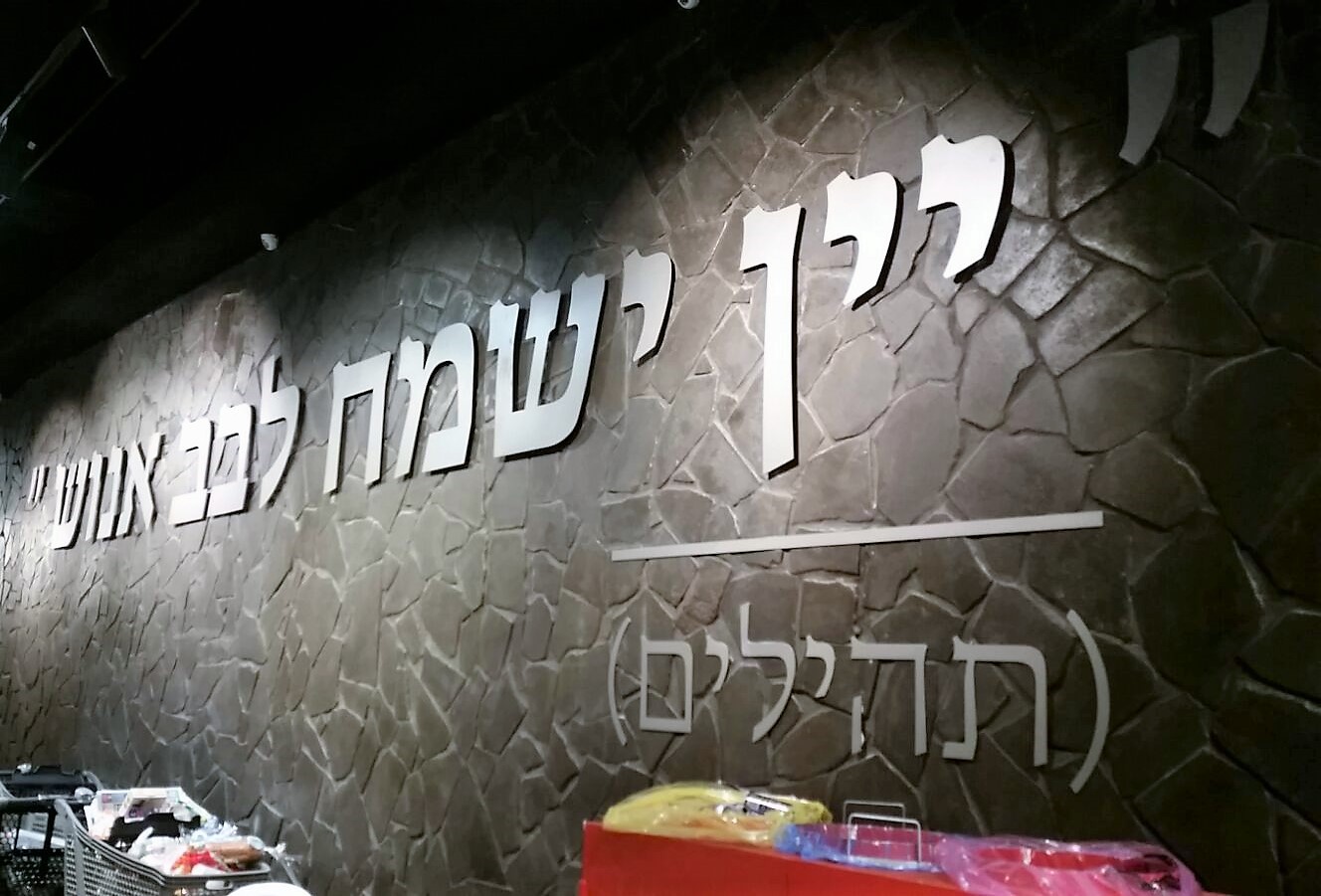
It's moving to see quotes from the Psalms in the grocery store.
My husband teases me that I will hunt down and photograph lizards and signs in Hebrew. True enough. There are so many varieties of lizards here, and much to learn from the signs, more and more of which I can understand. There is often humor in the simple phrasing that is worth understanding, as well as deep meaning and philosophy peculiar to Israel. The Dearly Beloved also has fun at my expense as I go around Jerusalem seven weeks after Yom Kippur and joyfully say "Melakam Sigd" to as many Ethiopians as possible. More smiles. (Truly, is there anything more delicious in this world than bringing smiles out of human faces?)

We have embraced the rhythm of Jewish holidays that make so much more sense here in the Land of their birth. And having the whole country more-or-less on the same holiday page at the same time is such a blessing, after years of being an afterthought in a tiny kosher section of Safeway and Wal-Mart. It rains most of the time when it's supposed to – even God doesn't like to be too predictable, I imagine – and there's no snow in the sukkah. Nearly everyone, nearly every car, stops for two minutes of silence to remember our fallen. Chanukah lights and Pesach decorations and children dressed as Queen Esther and Mordechai are prevalent throughout the country. There are hand-washing stations at the majority of restaurants; and even the less obviously religious don't bat an eye when seeing a fellow traveler reading prayers or Tehillim, or saying a blessing when leaving a restroom. "Homeness" surrounds and embraces.

Things that used to bewilder us now delight at best, or are quaintly annoying at worst. Why does every food package come in one-kilo bags, instead of in five-kilo bags? (No worries. It very seldom costs more in the smaller package.) Why can you get good service throughout the meal, but have to hunt down the waitress for the check? (Now that I think about it, what's bad about more time over the coffee and conversation at the end of the meal?) Why can't you walk anywhere in the country without meeting a beggar with his or her hand out? (It's a good reminder that I'm very blessed to have enough to eat.) Why do office supply stores and furniture stores also sell wine and other food products as special sales? (See what I mean? Quaint. Even adorable.)

I could go on for far too long... but you have things to do. I guess I'll close these thoughts with gratitude to Hashem. We miss our friends and family back in the States, and look forward to greeting you here whenever you can come. We are blessed to have electronic means of communication unheard of a decade ago, and these will surely only get more advanced. (Think a Princess Leia hologram visit, right in the comfort of your own dwelling.) And we have been blessed with friends here in Israel who are from many different countries and who speak many different languages. Their main common feature is that they fill up the extended family spaces for which our hearts have yearned.

Looking forward to the next decade and more, here at HOME!


Photo credits: really cute granddaughter, Nisan Jaffee; Avi and Ruti, Chanie Barami


Sunday, February 12, 2017

Second Meltdown in Nine Years

Yom rishon, 16 Shevat 5777.

Dear Lady in the Audience: Thank you for publicly reminding me how stupid I am. Love, Every Olah Chadasha in the Audience with You

When I arranged to attend the concert, I really didn't expect to understand anything. I was just looking forward to a night of good music by a really cute and talented duo.

Because there are a lot of Anglos in the community that hosted the event, the musicians asked if they should speak between songs in Hebrew or in English. An overwhelming segment of the audience requested English. Though I didn't vote, I was relieved. There was hope I would understand something, which would add to my appreciation of the performance. Perhaps they would say a little about each song, thereby giving me a "hook" upon which to hang my efforts at translation...

But halfway through her first statement, the delightful young artist was shouted down by the all-too-familiar refrain: "Rak b'Ivrit! Anachnu biYisrael!" (Only in Hebrew. We're in Israel.) The small but intimidating band of possibly Israelis from birth but more likely olim vatikim persuaded the young lady to switch back to Hebrew. I tried vainly through the evening to understand more than a word here and a word there -- but as usual, I didn't get the jokes, and didn't understand much of anything else, within the mostly Hebrew songs and their accompanying explanations.

I worked hard to get past this, to no avail. Of course, the shouter was correct. We live in Israel, we should speak Hebrew. God knows, I'm trying, with many ulpanim under my belt, and with four hours a week with study partners, as well as independent study throughout the week. I'm getting better, l'at, l'at, but enough fluency to understand people speaking faster than the Pimsleur lady is still an oasis shimmering far off on the desert sand. At nearly 60, I have to admit that the fact that my sons are all fluent and many of my grandchildren will be fully bilingual may be the most pride I will attain in this wonderful but oh-so-foreign tongue.

I listened to the songs, tried to interpret lyrics and sweetly-worded commentary, and finally tried to relax my jaw while I mentally penned a "love note" to the shouter.

Dear Israeli Lady or Olah Vatikah:

While you are of course correct, I am guessing that living in this town, you either have passable English, or are more likely a person who came from an English-speaking country when you were 30 or younger, and managed to immerse yourself in this beautiful language, and got it. Kol hakavod to you! I am duly impressed.

But would it have harmed you in any way to let those of us in the audience -- who struggle daily to understand our phone bills, arnona notices, bituach leumi reminders, even our grocery bills -- to have even a partial comprehension of what you probably could have understood in both languages? And even if you are Israeli, and struggle with English, couldn't we have split the difference -- you understanding the song lyrics, and me understanding the commentary in between?

Thanks for reminding me that I'm too stupid to accomplish what you so proudly did.

I have to say that I was so depressed by the ordeal, I thought briefly of calling my various chavrutot and saying "Let's give up. It's not working."

Briefly. Because even though it is still a struggle, even though I don't know if I'll ever "get" this language entirely -- I am getting better all the time. I can make myself understood, even though we have to often potchky together the conversation with bits of Hebrew and English and body language. If someone has something important to impart, I know how to ask them to slow down, to speak to me as if I were a child (meaning that they should leave out all the extra words, and cut to the chase). It delights me that as we try to communicate in Hebrew, many Israelis discover that their high-school English isn't as bad as they thought it was. We work it out, in two languages.

My mood was rescued near the end of the performance when one of the singers was thanking us. She ended by thanking in English those of us "who didn't understand anything we said tonight." I appreciated her acknowledgment. And then she did an even sweeter thing, by finishing with a song that said it all: a lovely and heartfelt rendition of a song by Jason Mraz with the line "We've got a lot to learn, but God knows we're worth it." I felt validated, and embraced. As if she were saying, "It's okay, Aunties and Uncles. I know you're trying. Don't give up. I hear you."

I bless all of us that we will have the brain cells and pertinacity to keep trying, and to have people around us who remind us that we are improving, slowly, slowly. I bless us further that we will always retain the humanity to remember with kindness and patience those who are struggling to climb whatever pinnacle we ourselves have managed to surmount.

Glossary:
Olah Chadasha: new (female) immigrant (male would be oleh chadash)
Anglos: English speakers
Olim vatikim: veteran immigrants; immigrants who've been here for a fairly long time
Ulpanim: Hebrew language classes, the best of which are Hebrew study in almost exclusively Hebrew
L'at, l'at: slowly, slowly -- what every comforting Israeli says about every immigrant's efforts at the language
Pimsleur: a very patient style of study that builds comprehension syllable by syllable
Arnona and Bituach Le'umi: Don't ask until you live here. Once you do, you'll understand. Taxes and insurance.
Chavrutot: One-on-one study sessions (chavrusas in America)
Potchky: probably Yiddish for sticking together haphazardly, hodgepodge
Mraz: I haven't a clue where that name comes from, or if it's an actual word -- but he writes pretty songs


Sunday, April 26, 2015

Miracles that Follow from Making Nice

Yom sheni, 8 Iyar 5775.
[Originally written in August 2014.]

An ID card that actually fits in the wallet
I wrote long ago about our first appointment at Misrad HaPnim (the Ministry of the Interior) to get our very first teudat zehut (ID card). Details: Anat, our Israeli p'kida (clerk) was not going to let us become citizens, because after the grueling question and answer session she put us through, she couldn't find the raised stamp on the Dearly Beloved's birth certificate. Finally, miraculously, she was able to feel it. (Okay, we're also old and faded...) Too much suspense. But at last, we became citizens.

While my son Soldier Boy was here for his brother's wedding, we returned to Misrad HaPnim to replace his expired teudat ma'avar (temporary travel document), and to get my very first darkon (passport). (The teudat ma'avar works just fine for the first several years; and one is permitted to renew it three times.)

First we stood for a very long time in the sun, waiting for the misrad to open, in a long line of other hopefuls. To his eternal credit, Soldier Boy did not complain, even finding ways to look at the situation in the most positive light. (I love getting to know my children as adults!) Finally, finally we went inside. I typically carry a small Swiss Army knife with me. After years of experience, I now carry the smallest, least-scary knife possible, assuming that no security guard in his right mind could possibly see this as a weapon. Today, however -- perhaps due to heightened tensions? -- the security guard removed my immature little knife from my possession, had me fill out a form to reclaim it later, wrapped it in his copy of said form, securely taped it, and locked it into a safe. Shaking my head and chuckling, I followed the ever circumspect Soldier Boy to the next line, where we were told that his document would cost 560 shekels (nearly $160 at today's rate, and more than I had on me) to replace, due to loss. That pretty well nixed the idea of both of us walking out with documents. But his was critical. I would pay for part of it, and charge the rest, if they would let me. We took our number and sat down.

I fretted for a while, and he reassured me. "What's the worst? They'll tell us we have to come back tomorrow." Okay. He was right...

After a not-too-long wait, our number appeared on the LCD display with instructions to go to Window Number 7. Having the superstitious instincts of any sports fan (or gematria maven, for that matter), we were heartened by the fact that this is the Dearly Beloved's favorite number. Who should be our p'kida? The lovely Anat! Nearly seven years later, and we got the same clerk! And I remembered her, and her name, which almost never happens for me. "Ha-shem shelach 'Anat'?" I asked, a little warily (due to my usually terrible memory). She was awed that I remembered her after all these years. I told her that we had been very grateful that she was the person who approved our citizenship, and that we had had a nice conversation about her children's artwork (no longer posted). I didn't see any need to remind her of the less-positive aspects of our first meeting.

To cut the long story short -- Anat smiled through giving Soldier Boy a lecture (or six) about no longer living in Israel, and telling us that his teudat ma'avar would cost us only 140 shekels!!! We both gratefully signed papers for his documents and mine -- all of which cost less than the original quote for his single document.

My first Israeli passport, making me 37% more Israeli
No one loves bureaucracy or bureaucrats. But sometimes if you treat them like people with lives and children and stories outside their little cubicles and annoying rules, they can surprise you by returning the favor.

My embarrassingly tiny Swiss Army knife
Post script: As we were leaving (jubilant, because it had ended very well), we stopped at the security desk to retrieve my pocket knife. The guard finally located the very tiny package, but insisted on checking the signature on the paper wrapped around it. The knife fell out of it's paper cocoon as the guard struggled to remove the tape.

"You can use the knife to cut the tape if you want to," said Soldier Boy. The guard was offended at the suggestion. Soldier Boy -- every helpful -- opened the tiny knife and offered it to the guard. "Really. It will make it easier." The guard (rather than arresting Soldier Boy for pulling a tiny knife on him, which is what I was anticipating) made some Israeli noises that equated to "Back off, buddy. I'm in charge here," and went back to tape wrestling.

He was finally successful. But I couldn't help but think that my son needs to return very soon to Israel. We need a little good old-fashioned American ingenuity to get us through the coming years in the Middle East.

"Hey, Shai! Use the tiny knife to cut the tape!" "Ah, chabibi! What a concept!"


Sunday, January 25, 2015

Potatoes in bread is as funny as it sounds.

Yom rishon, 5 Shevat 5775.

A pleasant and informed voice from the West breezed through Neve Daniel last night.

Herb Keinon hasn't lived in Denver for at least 30 years, and has made Maale Adummim in Israel his home. But when someone interjects certain kinds of expressions into his talk, I feel very nostalgic for my upbringing in the western United States.

"When someone comes up to me and says 'Can I ask you a question?', I know I'm in for a shellacking." He says it with that slightly sheepish behind-the-woodshed look that suggests he came from a time and part of the US where such an expression was common. Made me feel right at home, as did his total approach of easy-going, self-effacing humor, surrounding confidence in his knowledge of his subjects.

I've been reading Herb Keinon's political posts and life commentaries in the Jerusalem Post since our Baltimore rabbi, Rabbi Menachem Goldberger, first told us about him. Apparently, the two go back to childhood. In fact, It was Rabbi Goldberger the elder, zt"l, who gave Herb his Hebrew name of Chizkiyahu, which he never got used to using, even in Israel. "I tried going by 'Chezky' for a while, but the Israelis thought that meant my name was 'Yechezkiel.' I should have just gone by 'Yahoo.' That was back in the days before Google..." His voice trails off in our laughter.

Keinon's stories are a pleasure to read. With the style and skill he has honed after years of writing professionally, he writes about his family with humor and tenderness, but never with meanness. He spoke about why he calls his wife "The Wife" unashamedly, despite frequent shellackings from well-meaning street corner critics who assume he hasn't checked with The Wife to see if it would bother her. (This resonated with me, as I am often asked if my sons and daughters-in-law are bothered by their nicknames in my blog, and about what I write about them. It's hard not to respond with a little gentle sarcasm. "Oh, wow! Maybe I should ask them! Thank you for the tip!")

Another favorite topic in Keinon's writing is the evolution of the oleh (new immigrant) in Israel. Many of us were nodding our heads in recognition as he spoke about the attitudes with which we arrive in Israel -- our impressions of the Israelis as loud and rude and a little stupid ("Why do they leave the windows open in the winter???") -- and how we "grow up" and realize that these Israelis are the way they are for a reason, and they really aren't that dumb. ("Ohhhhhh! If you leave the windows open a little each day in the winter, you reduce the retivut, the mold, on the walls!")

Keinon spoke at some length about what a fretful people we Jews are, especially here in Israel. If there is something going on at a border, we're sure it's war. We're constantly fearing earthquakes, disease, price explosions or catastrophic drops... "If there's a silver lining, we'll look for the cloud." It was easy to laugh with him at ourselves.

After speaking a little about politics and a lot about the aliyah experience -- the main subject of his delightful new book French Fries in Pita -- Keinon shared a few impressions of some of the leaders he covered over his fifteen years on the diplomacy beat. He was surprised that the most generous interviewee was Ariel Sharon, a"h, who gave him a very long interview just after the death of Sharon's wife Lily, a"h. Sharon surprised Keinon by asking about his life. But Binyamin Netanyahu is "all business," apart from one joke about his name. When Keinon arrived for the interview, Netanyahu said, "Come in, Herbal Tea." Keinon thought for a moment, and returned, "With all due respect, Mr. Prime Minister, they call you 'Bibi,' and you're making fun of my name?" I can't remember if he said that he actually said those words, or only thought them. It would have been a great response.

During the Q & A, participants had lots of ideas about how to improve the government. In his answers, Keinon proved his point about the need to be in Israel long enough to understand the subtleties of how the political system works, even when it doesn't, and why overlays from other countries' systems simply cannot work in this very odd little country. I'm not sure all of the participants were convinced -- well, that wouldn't be Jewish, would it? -- but my sense was that his main point is very well taken. Israel is not like any other country in the world; and no other political system would be able to take all of the citizens and ideologies into account. But I suspect we'll be debating this for a long time -- at least as long as Israel keeps going to elections every two years, and as long as there are olim with opinions.

Another point brought up by a member of the audience was that hasbara -- the Israeli word for PR -- doesn't seem to be working out there in the larger world. Keinon pointed out that we are getting the message across to the United States and Canada because the people there whose support we need are more receptive than they are in other countries. Europe simply isn't interested in hearing what we have to say, at this point. While there are individuals in Europe who are very pro-Israel, the majority of the continent is currently only interested in accepting the Palestinian narrative. Dabbling in the field of hasbara myself, I am in total agreement with this point.

If you haven't been reading Herb Keinon's posts in the Jerusalem Post, give yourself a treat and start reading them. "There is no such thing as objectivity in journalism; but I try to be fair." Indeed. He is as fair as one can be (in my opinion). And entertaining, concise, and very readable.

French Fries in Pita is available at Amazon (in a Kindle edition), and at Book Depository (which delivers free to Israel) and in M. Pomeranz Bookseller, my personal favorite, because it's in Jerusalem and is my favorite book store on the planet.

Thank you to Chaim and Ruth Sherman for hosting this enjoyable talk! "What's said in Neve Daniel stays in Neve Daniel." Okay... maybe not so much. We are Har HaBloggerim, after all!

Tuesday, March 18, 2014

Ezra's Aliyah - a children's book review

Yom shlishi, 16 Adar II

Aliyah is not easy for adults. For children, it can be bewildering. Sometimes parents make the mistake -- in life in general -- of forgetting to see change through the eyes of their children. And even those for whom their children's perceptions are paramount can use a little reassurance that they are covering all the bases.

Tzivia Jennifer MacLeod's newest book, Ezra's Aliyah, tries very hard to anticipate the questions and concerns of her young character; and she doesn't sugar-coat or dismiss his objections or his worries. She states truth with simplicity.

One example: there will come a time when Ezra will speak Hebrew better than his parents. Her simple statement of the fact has wisdom, for it can prepare children and parents, and take away any negativity associated with this eventuality. She also drops excellent hints about how to make the transition to life in Israel less painful (for example, packing unnecessary but comforting cake mix for Ezra's upcoming birthday).

I liked Ezra, his sense of humor, and his honesty. His parents' honest answers to his questions were appreciated. The illustrations were a pleasing combination of cheerful cartoons and photographs.


I was sometimes confused by the order of the illustrations: there is a photo of grandparents without any comment about grandparents where I would have expected it; and when Ezra's grandmother at last appears, she doesn't look like this grandmother. (The other grandparents? Random elderly Israelis? I don't know. Will a child reader notice or care?)

Back to my favorite part of this sweet little book. I can feel Ezra's worry, hesitation and hope as I read. Here is one passage, in which he tries to imagine his future through past associations:

"A couple of years ago, a new kid came to our class.
He didn't speak much English. Nobody talked to
him, but then it turned out he was a great basketball
player, and everybody wanted to be his friend.

"Will the kids in Israel talk to me? I hope so. I'm not
so good at basketball, but I know a ton about planets
and about astronomy."

Someone once said of aliyah: "Don't make your dream your children's nightmare." This lovely little book is a step in the direction of preparing children for aliyah by taking into account that their aliyah experience matters, too.

About the Author: 

Jennifer Tzivia MacLeod is a proud mother of four (two big and two little), who recently made aliyah to the north of Israel. A freelance writer for magazines and newspapers, she also loves writing stories for her kids and their friends.

Follow her own aliyah adventures at: http://aliyahland.blogspot.com

While her book can be purchased at Amazon, the author has a special going on right now: her two newest books (Ezra's Aliyah; and Zoom! A Trip to the Moon) for $9 plus shipping. To take advantage of this sale, go to her website Write Kids' Books! Tell 'em Ruti sent you. It won't get you a bigger discount; but it will make Tzivia smile.

All illustrations used with permission of the author

Tuesday, August 20, 2013

Understanding Israelis

Yom shlishi, 14 Elul 5773.

This post hopefully will serve three purposes: it will illustrate one of the subtleties of transitioning to a new country; it will allow me to express hakarat hatov (gratitude) to an anonymous soldier for a kindness; it will give readers the opportunity to share (please!) stories of kindnesses done to them, by soldiers, or by any Israelis.  Thank you for playing along!

One of the facts of immigrating to a new country, language and culture is that you take a while to understand the nuances.  An example is the frustrating juxtaposition of IDF soldiers and civilian buses.  A couple of years ago, I wrote about this from a humorous standpoint in a post with the (if I do say so myself) intriguing title IDF storms bus; civilians victorious.

As time goes by, you can learn the reasons behind certain behaviors, if you are willing to begin from the premise that people are not rude, just differently-cultured.  When I was in the US army, we had troop transport buses that were never used by non-affiliated civilians.  While a service member could certainly use public transportation, civilian buses were not used, at least during peace time, for mass transportation of military personnel.  But Israel spends its military budget differently; and I am certainly not in a position to determine if the money is spent wisely.

Not having their own transportation system puts IDF soldiers into a difficult position.  Most soldiers try to stay at home until the last possible bus -- because they want as much time as possible with family, their own beds, and normal food.  Some of them are just exhausted.

Sports Guy trying to sneak in a few more z's before the morning bus.

As my newly-married soldier son, Yeshiva Bochur, explained to me:  "Ema, most of the guys I serve with were raised with good midot.  But we are told by our commanders that if we don't make it to the base on time, we will be punished by losing Shabbat.  They don't care if there is traffic, if we miss the bus, if the bus breaks down.  Somehow, that's all the soldier's fault.  And we really want to see our wives or girl friends and families.  We will get on that bus, no matter what."

I know that he's right.  I've heard the negotiations on the phone with the mem-mem (acronym for "platoon commander").  To be fair, there are married commanders who understand, or those who are simply sensitive and fair.  But there are also a few commanders who like to throw their weight around and enjoy the power of punishment.  Stunt Man tells a story about a bus that was supposed to get the soldier to his base an hour ahead of schedule. The bus got stuck in traffic in a tunnel, behind a bus that had caught on fire.  The soldier had a copy of the bus schedule, as well as cell phone photos of the bus on fire... but his mem-mem blamed him for the three-hour delay.  "Not fair" doesn't begin to cover it -- but most soldiers just want to get through their service without making additional waves, so they don't do much more about such commanders than grumble.

And crowd the next bus to get in ahead of anyone who might cause them delay.

Once everyone gets on the bus, a soldier will very often give up his seat for an older person or couple, or for a pregnant woman or a mother with children.  (In fact, Sports Guy had a commander who told his soldiers: "If I ever get on a bus and see one of you sitting while a citizen is standing, you will be punished." Sports Guy had great respect for that commander.)

This background is all leading up to a thank you to an anonymous soldier.

Dear Chayal,

I know you were tired.  It showed.  By the ring on your finger, I could see that you had probably just said goodbye to your wife, and perhaps kissed your still-sleeping children's heads.  Making sure that you got on the bus was very important to you, as I have learned from my own soldiers.

Nonetheless, as it looked like seating might be limited, you surrounded the doorway (in a stretching and swelling maneuver of the body at which Israelis and even olim vatikim begin to excel), keeping anyone from entering until I and two other older ladies were aboard.

I am grateful you got a seat, and I hope that you will never, ever be subjected to a foolish punishment that keeps you from your dear family.

If I would meet your ema, I would be happy to tell her what a good job she did raising her son.

I look forward to learning more about the reasons behind the behaviors that now infuriate, confuse or amuse me.  I must remember that being dan l'chaf zechut is an important part of being a Jew, and a great way to develop love for one's new country and its people.

Glossary:
Midot - character traits
Chayal - soldier
Olim vatikim - immigrants who have been in Israel for a few years
Ema - mama
Dan l'chaf zechut - the Torah requirement to give the benefit of the doubt, to assume the best in people rather than the worst


Tuesday, July 9, 2013

I LOVE THIS COUNTRY!

Yom shlishi, 2 Av 5773.

Idit and Ella: Golani sheli!
You know how when you're at home, you can get away with acting a little goofy, and people tolerate it?  Because they know you, and they love you, in spite of (or because of) your goofiness.  You can't get away with that stuff away from home.

So I'm walking around Jerusalem one day last week, and I see that it must be "Golani Soldier Day," because there are Golani soldiers everywhere.

Because Soldier Boy -- my eldest of four soldier sons -- was Golani, I can't help feeling a certain affection for all Golani soldiers.  They're all "my boys."  And as every Golani parent can affirm, whenever I see them, I want to sing a bar or two of their anthem to them.  "Golani sheli, Golani she-leeeeeee!"  There are rules in Judaism about men hearing the intoxicating sound of my amazing voice -- down, boys! -- so I can't do that.  Instead, I just think the song to myself, and send them a proud mother smile.

On this day, however, I had a special treat: two female Golani soldiers walked into a pet store.  Hah!  No rules of kol isha!  Overwhelmed by the goofiness instinct, I followed them in, and said, "Ah, at last, I can do something I always want to do... 'Golani, sheli...'" I sang to them.  And they joined in, and quietly we serenaded each other, followed appropriately by giggles.

We interviewed each other.  They wanted to know where I was from, now and before aliyah.  We spoke about my soldier sons.  I asked them why they chose to serve in Golani.  "Because it is how we felt we could best serve our country," said Ella, and Idit agreed.  Such a logical statement.  But they might have said, "Because we have to." or "Because we were drafted."  I don't meet too many young people in Israel with a negative attitude about their service.  Maybe about their base, or their commander...  but rarely about serving their country.  (They also informed me that Golani is superior to all other branches of the IDF.  First time I've ever heard that from a Golani soldier.  Not.)

@%@%@%@%@%@%@%@%@%@%@%@%@%@%@%

"The Brothers," as they and everyone else call my sons, have always worked at being close friends (when they weren't beating the pasta out of each other, of course.  We raise men here, not saints).

As Soldier Boy and his bride Executive Girl are temporarily detained in the States for an unspecified duration, the Brothers -- Yeshiva Bochur, Stunt Man and Sports Guy -- can sometimes be seen huddling over the computer, chatting with their big brother on Google's Hangout.

I love that being in this country has strengthened their love for one another, and their friendship.  I don't know if the IDF helped with that, or gave them more to argue about.  ("Golani guys go through walls instead of over them."  "Yeah, well that's because Tzanchanim are too chicken to face the wall head on, so they fly over it."  "At least Shirion guys go through the wall in tanks instead of with their heads."  "Hah!  The only people crazier than Golani guys are bus drivers!"  "Oh, yeah?  Well -- your mother wears army boots!  [pause]  Oh, yeah... she did...")

@%@%@%@%@%@%@%@%@%@%@%@%@%@%@%

Got a call from Sports Guy after Shabbat.

"It was a good Shabbat, Ema," he said.  No special excitement.  It wasn't an amazing Shabbat.  It's just Sports Guy's way to be pretty accepting of his situation.  "I had guard duty at Ma'ariv [the evening prayer service]..."

"How was the food?  Any good?" I interrupted.

"Yeah, well, no, actually it was pretty bad.  [He laughed a little here.]  Except at Ma'ariv... but of course, I was on guard duty.

"So I was thinking 'Well, I'll just daven here by myself, then.  That'll be okay... and suddenly I see all these people walking toward me.  I thought 'Okay.  No big deal.'  But as they're coming toward me, I see it's all the dati (religious) guys, and even some chiloni (secular) guys, but they're wearing kipot... and the rabbi is with them...

"And the rabbi says to me, 'If you can't come to the minyan... the minyan will come to you!'

"And all those guys came to the guard shack, and we davened Ma'ariv right there."

"Wow!" I said, truly overwhelmed with love for these soldiers, and this rabbi.  "So it was pretty good after all -- except for missing out on the good food," I said with a wink he couldn't see.

"Oh, no, Ema.  I didn't miss out.  Somebody brought me food, too..."

I've said it before, and I'll say it again:  I LOVE THIS COUNTRY!!!

Sunday, June 2, 2013

The Fonder Heart

Yom rishon, 24 Sivan 5773.

It is very hard to be an ocean away from people you love.

That is the hardest thing for me about aliyah.

But I truly cannot complain.

I made aliyah in a time more technologically-advanced than I could have imagined when I first entertained the idea, back in the "olden days" of the early '90s.  I can visit my grandchildren (even babysitting one of them briefly!) via Skype or Google Hangout.  I can once again sit in the dining room of my Rabbi and Rebbetzin, chatting about Israel, and about how blown-away we are by technology.


I can spend a glorious hour on Mother's Day watching a grandson walking around in his dragon outfit, trashing his parents' house as he shows me every. toy. he. owns.  (Who says you have to "be there" to drive your children crazy?)


And sometimes, on Erev Shabbat, my Soldier Boy in America can sing Shalom Aleichem and Aishet Chayil to his mother, after learning Mishnayot with his father.

Thank You, Hashem.  It will never be easy to be away from those we hold dear.  But thank You for making it easier than ever before to "touch" each other, even while holding fast to our ideals.

You never promised us that this life would be easy, or comfortable.  But in this time, You have wrapped the difficult in a lot of clearly-discernible love and compassion.


Happy 28th wedding anniversary, Dearly Beloved!  Thanks for helping me to raise these amazing young men!

Thursday, October 11, 2012

Party! Party! Party!

Yom chamishi, 25 Tishrei 5773.

Yesterday was our fifth "aliyahversary."  Woo-HOO!  How did we celebrate?

The Dearly Beloved coached his football team.  He had to wrestle with executive decisions about where to play which guys, who worked best on offense and who on defense, and which guys needed to be cut from the developing team.  This is a very difficult decision, as he knows that all of those guys want to fulfill childhood dreams.

Sports Guy went to the team doc and got a dislocated shoulder Kinesio-taped with pretty blue tape.  And then he stayed up most of the night with good friends from Baltimore, watching the Orioles and the Yankees duke it out over who will go to the World Series.  (I don't hear any fat lady singing yet, New Yorkers...)

Stunt Man sat in a classroom -- as all of his former rebbeim and teachers know, NOT his favorite pastime -- taking advantage of one of his Israeli army benefits: preparing to pass his bagruyot.  (Think high school finals combined with college SATs.  All in Hebrew.  Talk about combat!)

Yeshiva Bochur surprised his girlfriend, Champagne Girl, who is living with us temporarily.  (This precious girl has earned this sobriquet by being as uplifting and optimism-enhancing as a glass of champagne.)  It is always a delight when Yeshiva Bochur appears at the door after a long stretch with his army unit.  That delight is enhanced by watching her bubbling joy at his arrival.  (There is something very sweet about watching a beautiful young lady's appreciation for one's son.  Good taste, has our Champagne Girl!  What better affirmation is there that we parents did a good job!)

And how did I celebrate?

There's nothing as powerful as "sister support."
I had real coffee for a change with eleven of around thirty "virtual" friends.  We have been meeting in our special Facebook group for about eight months to chat over our morning or afternoon coffee; and it just seemed important to finally meet -- as one of our very computer-lingo-hip members says -- "f2f" (face to face).
Celebrating five years over Israel's national beverage.
There were two women-and-daughter teams in attendance (and one remarkably well-behaved and patient baby, our only male attendee).  We covered a range of ages, and boasted aliyah dates spanning from just last year to 1967.

We spent more than three hours together!

Women told amazing stories of struggle and survival, physical and spiritual and emotional in nature.  We shared various uplifting life philosophies: "You can't really know someone else until you hear her story."  "Think good and it will be good."  "I believe in living a purposeful life."  "Age isn't about wrinkles.  It's about giving up a sense of wonder."  "I've spent the last twenty years trying to earn the privilege of living in Eretz Yisrael."  (The one who offered that surprising revelation has given so much to Israel, she has more than earned her privilege!)

We ended our get-together by dividing up the recitation of the 150 chapters of King David's Tehillim, in the merit of those with serious illnesses, and of those looking for their life's partner, and in the honor of our founding member's father's neshama.  This would be meaningful at any time; but there was a very special glow in that room, filled by the stories and the appreciation of those stories, that made the prayers soar.  I was very moved by the fact that all of my designated chapters spoke so specifically about the character of the ladies I'd met!

As we know, nothing happens for "no reason."

May we share many more cups of virtual coffee, and also many hot, steaming, real cups -- f2f.

This post is dedicated to Paula, Tamar, Anita, Chaya Golda, Drora, Rachel Ann, Chava, Freyda Minna, Angela, Toby, Hadassa, Hadassa, Chloe, Rose, Fayge, Esther, Janet, Miriam Esther, Linda, Bracha, and Chava.  See you next time, gals?  Coffee pot's on, and your chair at the table is waiting.

Glossary:
Aliahversary: the anniversary of one's aliyah, immigration to Israel
Rebbeim: plural of rabbis, here meaning school Judaica instructors
Bagruyot: the tests all Israeli high school students spend their last instructional years to pass, to prepare for college entrance
Tehillim: Psalms, customarily recited in groups or individually in times of trouble or great longing, or even great joy
Neshama: soul

Sunday, August 26, 2012

Hebrew Lessons in Cyberspace

Yom sheni, 9 Elul 5772.
Flash cards.  I don't know if they help, actually.  But they don't hurt.
It's the month of Elul -- and besides trying to get our act together spiritually before Rosh Hashanah, it is also a time when Jews start putting together the list of "Things I'm Finally Going to Improve.  Really.  This Year for Sure."  There can be no doubt that for the average oleh, the hardest struggle and the most important task is learning the Hebrew language.

There are no quick fixes.  People who immerse are much more likely to learn the language than people who live in communities of their linguistic peers.
Yeshiva Bochur saying "Lehitra'ot" to a favorite teacher at the Kibbutz Sde Eliyahu Ulpan at which he worked and learned for five months.
People who get jobs in the Israeli mainstream will learn faster, too.  "You want to learn Hebrew?" asked one friend.  "Go into business."  This includes kids in Israeli schools and soldiers.
Stunt Man and a friend from the Old Country barely speak pure English anymore.  "Or I'm going to Ireland, or I'm going to America after the army."  That is actually good Hebrew grammar.
For those of us (like the Dearly Beloved and me) who break all the rules of language immersion, staying in our little linguistic ghettos, working in our country of origin (either by commuting or by working on the internet in our mamaloshen), patience and persistence remain our most important tools.

There are a few additional tools, however, presented by individuals and organizations with the goal of helping the oleh to integrate as quickly as possible.  Lots of these tools cost money -- and some of them are so famous, they don't need my little blog to help them out.  Some are free, and for most people in my income tax bracket, free is a really good option.  Here is a sample of what is available out there in Cyberspace.


Ami Steinberger and Company at Ulpan La-Inyan make the experience of learning Hebrew as organic as possible, with topics that feel natural, using expressions and words that will come up in everyday situations.  Ulpan La-Inyan also teaches in a very natural way, the way a child learns language, rather than inundating the student with piles and piles of grammar laws.  Ami is an expert in Hebrew grammar -- so it is available.  Just not all-consuming of every last brain cell -- a fact which keeps his program fun, and effective.

Be sure to check out the Ulpan La-Inyan website, for more free stuff, and for the best ulpan available in Israel, when you are ready to get what you pay for.

Jacob Richman has made it his one-man mission to offer as many free aids to Hebrew language and cultural education as possible.  From online Torah to Jewish history and holidays, from recipes and radio stations to kashrut and clipart, Jacob's "Hot Sites - Jewish" is an aliyah resource to be visited again and again.


Another interesting website is Learn Hebrew Pod: Hebrew That Goes With You.  While the free lessons are actually a very nice sales pitch for the course, one can get a great deal even from these few free lessons.  The method of Hebrew conversation flowing more-or-less seamlessly with English translation is a refreshing approach when my mind is tired from more intensive study.

And if you haven't a lot of time each day to devote to learning the language, but want to feel "in the know" with a word or phrase added daily to your repertoire, you can also check out Transparent Language's "Word of the Day" in Hebrew, or of course, Ulpan La-Inyan's "Daily Dose" featured word or phrase, with detailed etymological explanations.

YouTube has lots of video clips from TV series and commercials in Hebrew.  I especially like the ads.  Good ads are often little short plays -- so one can feel a sense of accomplishment in finally understanding the little story in a one minute (or shorter) format, that can be paused and replayed as necessary.


Finally, Hebrew language study is never as much fun as when it's sarcastic political commentary, with English subtitles (for clarity.  But don't forgo the opportunity to listen without paying attention to the subtitles, just to test yourself).  Caroline Glick's Latma TV is an exceptional example of the genre.  Wicked enjoyment.


I tell everyone that I'll be in ulpan till I'm eighty.  (I can finally say this well enough in Hebrew to make Israeli young people laugh.  This makes me cool in two languages.  Woo-HOO.)  Please feel free to share with me any sites you have that will fill the gaps between enough money for ulpan tuition.  I wouldn't want to disappoint Ami and my other instructors when I finally get back to the classroom.

Now if I can just lose those last five kilos before Yom Kippur...

Thursday, August 16, 2012

Rebels with a Cause

Yom chamishi, 28 Av 5772.
A Rebel greets a future IDF soldier
When I was young, I loved opportunities to work with the local theater.  But I never wanted to be on stage.  Too much pressure to get it right.  Besides, the best show was happening backstage.  We stage-hands, makeup artists, and costume and props people had more fun than either the performers or the audience.

On Tuesday this week, former Baltimoreans planned to meet at the Nefesh B'Nefesh welcome ceremony for the 350 new North American olim who joined us as citizens of the Holy Land.  Our goal was to gather to honor our fifth-year anniversary.  My family actually arrived later in the year -- but everyone was invited to catch up in the admittedly emotional atmosphere at Ben Gurion Airport, Terminal 1.  The news has covered more than adequately the highlights of the day: 127 young soldiers-to-be dancing joyfully with old friends and new; Prime Minister Netanyahu speaking to the group; Natan Sharansky and all of the usual Nefesh B'Nefesh lineup of inspiring speakers reminding guests and immigrants alike of why we have all come Home.

I didn't participate in the onstage party as I usually would have.  (If you live in or are visiting Israel, and have never done a Nefesh B'Nefesh welcome gig, do yourself a favor: make a point of going to greet the olim.  As Go'el Jasper once remarked, he was too exhausted at his own welcome ceremony to really appreciate it.  But when he attended the ceremony to greet other olim, he couldn't stop crying at the beauty of the experience.)

Instead, I was at the backstage party, hanging out with a bunch of orange-clad Rebels, as they unloaded baggage from the baggage carousels.


If you have trouble viewing the video, you can find it here on YouTube.

The Dearly Beloved, in his new life as guitar instructor and football coach, is now the proud head coach of not only the high school team, the Orli Print Ravens, but also of the Judean Rebels, one of the Israel Football League's ten adult teams.

One of our players, Tani  Kramer, has Nefesh B'Nefesh as his day job.  He had the idea that big, strong, strapping football players might be just the right guys for the job of unloading the amazing amount of very heavy luggage the new immigrants bring in, as they uproot their lives, and replant them in holy soil.

We were proud of our guys.  They worked hard, not stopping with just pulling bags and boxes off of carousels, but also organizing them so that the tired new immigrants could find their possessions easily.

It was a good day, hard as any Rebels workout, and just as satisfying.  A couple of Tel Aviv Pioneers even showed up to assist, and the cooperation was a pleasure to watch.

Which inspired in me a coach-mom prayer: Hashem, see the brotherhood on this "field"?  If You can inspire this kind of sportsmanship on the gridiron, maybe football can go back to what it was meant to be -- a game.

One of the greatest games a guy can play.
Not the whole detail -- just the first guys to show up for this game

Leave a bunch of high-energy guys with nothing to do in a big, open space, and they will toss a pigskin around to fill the time.  "We should get up for practice at 4 AM every day.  We're really good today."

One of the 127 new IDF recruits.  Thank you for your holy service, guys and gals!

Many Israelis got up at 4 AM to cheerfully greet the new citizens.

Apparently, a couple of the guys failed to catch the ball during one handed catch drills.

"Drop and give me ten!"  A man does what a man's gotta do.

Finally, the bags begin to show up.  Game over.  Or just getting started...


Coach gets right into the action with his boys.

Halftime.  Waiting with anticipation for the next onslaught.  "Smoke me, Coach!"

You can only imagine some of the weight these guys hefted.


Working together to make the whole process run smoothly


Hundreds (thousands?) of bags were carefully organized for easy location.

Our Rebels stand for "Hatikva."  The TV monitor shows the new IDF recruits.
Welcome Home, to all of the new olim.  And if any of you future soldiers have a little energy left over after your tour of duty, have you heard that there is American football being played in your new homeland?  See? You didn't leave everything behind after all...

Thank you Uria, Baria, Brill, Tani, Didi, Ari, Yaniv, Jaymes, Michael, David, Yitzchak, Jake -- and anybody else who showed up later to help.  It was a pleasure working with you guys.