If you haven't yet discovered it, I want to share with you the new blog of my friend Rachel Sharansky Danziger. This true labor of love was born when Rachel wanted to find a special way to honor the 50th celebration of the reunification of Jerusalem, which we will observe this year on May 24. Like all Jewish holidays, the observance will begin the night before, and continue throughout the day. But for Rachel and her readers, Jerusalem Moments began to capture the spirit of the celebration of the miracle that is Jerusalem 50 days before, on April 5, as Rachel knew that there is so much about Jerusalem to celebrate. From the lofty achievements to the daily grind, from the holy to the incidental, from the tragic to the joyous, Jerusalem is truly the City at the heart of our people's love affair with Israel.
Each day, Rachel spends time formatting the prose or poetry or snippets of commentary and remarkable photographs she has solicited from contributors throughout Israel. Each day, there are new treats for the eyes and souls of those who choose to pop in for a visit. If you begin to peruse the archives of this beautiful blog, you may as well put off doing the dishes or writing that report for a later hour: there is so much of value here to anyone who wants to celebrate our precious and holy Jerusalem. From knitting soldiers to talking pipes, from the heartbreak of Yom HaShoah and Yom HaZikaron to the boundless gladness of Yom HaAtzmaut, from even beneath the streets to the colorful mass of idiosyncrasies that is Mahane Yehuda shuk, you can get a taste of our Jerusalem.
Jerusalem Moments is about geography and history -- but it is mostly about the people that have made and continue to make up this most glorious of cities.
Rachel invites you to participate with your moments, your memories, your photographs of this grand City. Send your submissions to her at jerusalemmoments@gmail.com with a short bio and a headshot, and add your words and pictures to this delightfully diverse collection of viewpoints of Jerusalem's rebirth.
Jerusalem Moments can be viewed at http://www.jerusalem-moments.com/, and you can follow on Facebook here: https://www.facebook.com/JLMmoments/
Showing posts with label 1967 borders. Show all posts
Showing posts with label 1967 borders. Show all posts
Monday, May 1, 2017


Wednesday, November 26, 2014
In Times of Darkness, I'm Thankful for My Jewish Family
Yom chamishi, 5 Kislev 5775, Thanksgiving.
 Along with all of my fellow Neve Daniel residents, I received a note with the following several-times-forwarded message:
"this is what Har Nof ppl got on the door handle this morning"
I wasn't sure what to expect. Threatening messages, God forbid? In the current terror climate, after the events of the previous week, that was the first thing that came to mind. As soon as I opened the email and saw the first sentence of the note and the chocolate bar, I got a lump in my throat. Not of fear, but of an emotion you can only feel when you are surrounded -- physically or even only spiritually -- by family.
The letter basically says the following:
After I read it, I tried to tell the letter over to the Dearly Beloved... and by the time I was finished, we were both choking back tears.
There is much here that is beautiful. The act is touching, by itself. The letter and the gift of sweetness were from a community which was devastated by a terror attack in 2011 in which six members of the Fogel family were brutally massacred as they slept.
And while this is a beautiful story all by itself, there is more to this lovely deed that is worthy of note.
The love letter was delivered by the citizens of Itamar -- a primarily Israeli Dati Leumi community in the Shomron -- read that "settlers dwelling over the Green Line" -- given to a largely Anglo Hareidi community in Jerusalem -- read that "not East Jerusalem, and therefore mostly uncontested Jewish property." It is a reminder that we are all one family of Jews, undivided by how we dress or daven or learn Torah, where we live, or if where we live is considered to be politically correct. I only mention this to you in case you are fooled by the media into believing that when the going gets tough the family will be divided. We are truly one body with one soul -- and we are in this together!
On this eve of the American Thanksgiving -- this is something for which I am truly thankful.
"this is what Har Nof ppl got on the door handle this morning"
I wasn't sure what to expect. Threatening messages, God forbid? In the current terror climate, after the events of the previous week, that was the first thing that came to mind. As soon as I opened the email and saw the first sentence of the note and the chocolate bar, I got a lump in my throat. Not of fear, but of an emotion you can only feel when you are surrounded -- physically or even only spiritually -- by family.
The letter basically says the following:
Our brothers, dear residents of Har Nof!
The Nation of Yisrael is one body, with one soul.
The pain is universal:
The community of Yisrael is in terrible grief
and in deep pain.
In our difficult hours -- many of Am Yisrael stood by our side.
Now -- we are by your side.
You are in our hearts and in our prayers.
We add [our voice to the collective] Torah, faith and prayer
"In the name of all of Yisrael."
God's blessing upon you, only be strong and courageous!
With love,
The citizens of Itamar
After I read it, I tried to tell the letter over to the Dearly Beloved... and by the time I was finished, we were both choking back tears.
There is much here that is beautiful. The act is touching, by itself. The letter and the gift of sweetness were from a community which was devastated by a terror attack in 2011 in which six members of the Fogel family were brutally massacred as they slept.
And while this is a beautiful story all by itself, there is more to this lovely deed that is worthy of note.
The love letter was delivered by the citizens of Itamar -- a primarily Israeli Dati Leumi community in the Shomron -- read that "settlers dwelling over the Green Line" -- given to a largely Anglo Hareidi community in Jerusalem -- read that "not East Jerusalem, and therefore mostly uncontested Jewish property." It is a reminder that we are all one family of Jews, undivided by how we dress or daven or learn Torah, where we live, or if where we live is considered to be politically correct. I only mention this to you in case you are fooled by the media into believing that when the going gets tough the family will be divided. We are truly one body with one soul -- and we are in this together!
On this eve of the American Thanksgiving -- this is something for which I am truly thankful.
Wednesday, June 18, 2014
Our Mother Rachel Weeps: Bring My Children Home
Yom chamishi, 21 Sivan 5774. The end of Day 6.
I'm listening to Ruchama Raz in the background. Her sweet voice connects me with something old in me, before my birth, that itself is connected to this Land. I'm listening to this because my husband has told me to stop listening to the news so much. (I joke with him that one of the signs of an Israeli is news addiction. So I'm a real Israeli now.)
Stunt Man comes in with a tub of kruv adom (red cabbage salad). Towering over me, he asks with absolute trust in my kitchen wisdom: "Ema, could you smell this or taste this, if you don't mind, and tell me if it seems okay to you? It smells okay to me; but I'm not sure." Dutifully I smell. Taste. "It's fine to me. I wouldn't have any problem eating it." Except for the calories I can't afford, I don't say. He takes his tall, handsome frame out the door, after giving me that gently grateful smile... full of trust.
And I get tears in my eyes, thinking of three mothers, wishing with all their hearts they could say "Yes, you can eat that." or "No, that's not good for you. Throw it out."...
אנגן שיריך... I will sing poems...
And then Sports Guy comes in. "Can you wake me up at eight tomorrow?" "You don't really need it anymore," I chide him, gently, gently, loving my "job" of being his back-up alarm. "It's okay. If you don't want to, I..." "No. It's okay. I don't mind. Just letting you know that I notice you've been getting yourself up lately." To lay tefillin and daven, sometimes in his room, before he goes back to sleep before work. Before he leaves in his olive drab uniform.
And I get tears in my eyes, thinking of young soldiers, searching for boys only slightly younger than themselves, and their mothers who send them out the door, with kisses and prayers...
בארץ אהבתי... in the land I love...
Yeshiva Bochur drops by with laundry. "Do you mind if we come by for Shabbat dinner, Ema? It will be good to have all of the brothers home together..." All the brothers. And yes, I'll change the laundry, and hang the things that shouldn't be put in the dryer.
And I get tears in my eyes, hoping the boys -- all the brothers -- will be home for Shabbat dinner...
היו לילות, אני אותם זוכרת... There were nights, I remember them...
Soldier Boy calls me from the States, so very anxious to get back to this family, to his dear brothers, to this crazy land... He sings a song of love in his sweet, strong voice. He always makes me cry, even when there is nothing about which to cry. And I think of all the mothers who want to see their sons in the same room with them, to hear them laugh and sing, to hold them close...
And I get tears in my eyes, thinking of the prayers set to song, saying them fervently, for each and every boy and mother and every brother...
היה לי חבר היה לי אח... Be for me a friend, Be for me a brother...
Please God, bring them home. And don't let me take for granted a single day with these brothers.
I light a candle at precisely 20:30 with other mothers in Israel, praying that Hashem will rescue these boys in the merit of our Mama Rachel, and all her tears for her dear children... And then I tune back in, hoping for good news before another night of fitful sleep...


May we all share laughter and hugs and the wholeness of life and family, very, very soon.
איל בן איריס תשורה
גילעד מיכאל בן בת גלים
יעקב נפתלי בן רחל דבורה
Eyal, son of Iris Tasura
Gil-ad, son of Bat Galim
Yaacov Naftali, son of Rachel Devorah
 |
| The mothers of Eyal, Gilad, and Naftali |
Stunt Man comes in with a tub of kruv adom (red cabbage salad). Towering over me, he asks with absolute trust in my kitchen wisdom: "Ema, could you smell this or taste this, if you don't mind, and tell me if it seems okay to you? It smells okay to me; but I'm not sure." Dutifully I smell. Taste. "It's fine to me. I wouldn't have any problem eating it." Except for the calories I can't afford, I don't say. He takes his tall, handsome frame out the door, after giving me that gently grateful smile... full of trust.
And I get tears in my eyes, thinking of three mothers, wishing with all their hearts they could say "Yes, you can eat that." or "No, that's not good for you. Throw it out."...
אנגן שיריך... I will sing poems...
And then Sports Guy comes in. "Can you wake me up at eight tomorrow?" "You don't really need it anymore," I chide him, gently, gently, loving my "job" of being his back-up alarm. "It's okay. If you don't want to, I..." "No. It's okay. I don't mind. Just letting you know that I notice you've been getting yourself up lately." To lay tefillin and daven, sometimes in his room, before he goes back to sleep before work. Before he leaves in his olive drab uniform.
And I get tears in my eyes, thinking of young soldiers, searching for boys only slightly younger than themselves, and their mothers who send them out the door, with kisses and prayers...
בארץ אהבתי... in the land I love...
Yeshiva Bochur drops by with laundry. "Do you mind if we come by for Shabbat dinner, Ema? It will be good to have all of the brothers home together..." All the brothers. And yes, I'll change the laundry, and hang the things that shouldn't be put in the dryer.
And I get tears in my eyes, hoping the boys -- all the brothers -- will be home for Shabbat dinner...
היו לילות, אני אותם זוכרת... There were nights, I remember them...
Soldier Boy calls me from the States, so very anxious to get back to this family, to his dear brothers, to this crazy land... He sings a song of love in his sweet, strong voice. He always makes me cry, even when there is nothing about which to cry. And I think of all the mothers who want to see their sons in the same room with them, to hear them laugh and sing, to hold them close...
And I get tears in my eyes, thinking of the prayers set to song, saying them fervently, for each and every boy and mother and every brother...
היה לי חבר היה לי אח... Be for me a friend, Be for me a brother...
Please God, bring them home. And don't let me take for granted a single day with these brothers.
I light a candle at precisely 20:30 with other mothers in Israel, praying that Hashem will rescue these boys in the merit of our Mama Rachel, and all her tears for her dear children... And then I tune back in, hoping for good news before another night of fitful sleep...
May we all share laughter and hugs and the wholeness of life and family, very, very soon.
איל בן איריס תשורה
גילעד מיכאל בן בת גלים
יעקב נפתלי בן רחל דבורה
Eyal, son of Iris Tasura
Gil-ad, son of Bat Galim
Yaacov Naftali, son of Rachel Devorah
Sunday, June 15, 2014
When Will We Have Made Enough Concessions to Appease Our Supporters?
Yom rishon, 17 Sivan 5774.
Without the swearing and vitriol that this topic usually seems to arouse, I would like to hear a reasoned discussion on the possible scenarios.
There are (at least) two different opinions among those who claim to support Israel.
On one side of the discussion are those who, for religious or nationalistic reasons, believe that Jews are entitled to land beyond the so-called Green Line, that we have a right to populate and rule over the region called variously the West Bank, Yehuda and Shomron, or Judea and Samaria. On the other side of the discussion are those who, for reasons of the pursuit of human rights or merely for peace and quiet, believe that Jews have no business occupying the land beyond the Green Line, that this land rightfully belongs to the Palestinians. For the sake of this discussion, I won't present all of the arguments of each side, about which much has been written extensively already.
In 2005, the Israeli government attempted the experiment of removing Jews from Gaza. For years, no Jews were there (except for Gilad Shalit). It is true that Gaza was not left unmolested -- but only as a response to attacks on Israel emanating from Gaza. This did not bring an increase in peace. Those on one side of the argument saw this as proof that moving Jews out of the area was a mistake, only allowing for another (and nearer) launching pad for terrorism. Those on the other side believe that it was not enough, and that the terrorism will stop when Israel withdraws from all of the land the Palestinians claim.
For the sake of this discussion, I won't deal with the chimera of settlement construction, as it is only a stepping stone. Why does settlement construction matter? As has been proved many times, it is not about building new settlements in areas currently occupied by Palestinians. In most if not all cases, the construction is happening in existing Israeli communities. Settlement construction is offensive to one side of the argument because it indicates that Israelis are planning to stay on land the other side covets. So let's cut to the chase.
If I and my neighbors in Judea and Samaria left our homes and moved into other parts of Israel, would the attacks stop? If they did, if there were peace, I guess we would have to concede that the other side of the argument was correct -- that at least for the purposes of peaceful coexistence, moving out of these areas and leaving them to the Palestinians was the necessary approach. But if peace didn't ensue -- if instead attacks now moved into Haifa and Tel Aviv and other areas that (so far) many of Israel's supporters (within Israel and without) believe Israelis are entitled to inhabit -- would the other side begin to believe that perhaps the Arabs do not want peace at all, but merely an absence of Israelis, and specifically Jews?
Or would that side merely suggest that it is fine and understandable for the Arabs to still be attacking, because Israel waited too long to pull out, or because Israel isn't doing enough to support the new Palestinian state surrounding her, or because the Arabs have a legitimate right to further chunks of Israel?
When will it finally be enough? Is there any way to prove to those on the other side of the argument, to our friends outside of Israel and inside her (accepted) borders, that Hamas and Fatah and Hizbollah and indeed the Palestinian and greater Arab world have no intention of making peace with even a sliver of Israel?
Please pray for the safe and speedy return to their families the following young men: Eyal ben Iris Teshura (age 19); Gilad Michael ben Bat Galim (age 16); Yaacov Naftali ben Rachel (age 16, and a US citizen).
איל בן איריס תשורה
גילעד מיכאל בן בת גלים
יעקב נפתלי בן רחל דבורה
 |
| Last Thursday night, three yeshiva boys were kidnapped. |
There are (at least) two different opinions among those who claim to support Israel.
On one side of the discussion are those who, for religious or nationalistic reasons, believe that Jews are entitled to land beyond the so-called Green Line, that we have a right to populate and rule over the region called variously the West Bank, Yehuda and Shomron, or Judea and Samaria. On the other side of the discussion are those who, for reasons of the pursuit of human rights or merely for peace and quiet, believe that Jews have no business occupying the land beyond the Green Line, that this land rightfully belongs to the Palestinians. For the sake of this discussion, I won't present all of the arguments of each side, about which much has been written extensively already.
In 2005, the Israeli government attempted the experiment of removing Jews from Gaza. For years, no Jews were there (except for Gilad Shalit). It is true that Gaza was not left unmolested -- but only as a response to attacks on Israel emanating from Gaza. This did not bring an increase in peace. Those on one side of the argument saw this as proof that moving Jews out of the area was a mistake, only allowing for another (and nearer) launching pad for terrorism. Those on the other side believe that it was not enough, and that the terrorism will stop when Israel withdraws from all of the land the Palestinians claim.
For the sake of this discussion, I won't deal with the chimera of settlement construction, as it is only a stepping stone. Why does settlement construction matter? As has been proved many times, it is not about building new settlements in areas currently occupied by Palestinians. In most if not all cases, the construction is happening in existing Israeli communities. Settlement construction is offensive to one side of the argument because it indicates that Israelis are planning to stay on land the other side covets. So let's cut to the chase.
If I and my neighbors in Judea and Samaria left our homes and moved into other parts of Israel, would the attacks stop? If they did, if there were peace, I guess we would have to concede that the other side of the argument was correct -- that at least for the purposes of peaceful coexistence, moving out of these areas and leaving them to the Palestinians was the necessary approach. But if peace didn't ensue -- if instead attacks now moved into Haifa and Tel Aviv and other areas that (so far) many of Israel's supporters (within Israel and without) believe Israelis are entitled to inhabit -- would the other side begin to believe that perhaps the Arabs do not want peace at all, but merely an absence of Israelis, and specifically Jews?
Or would that side merely suggest that it is fine and understandable for the Arabs to still be attacking, because Israel waited too long to pull out, or because Israel isn't doing enough to support the new Palestinian state surrounding her, or because the Arabs have a legitimate right to further chunks of Israel?
When will it finally be enough? Is there any way to prove to those on the other side of the argument, to our friends outside of Israel and inside her (accepted) borders, that Hamas and Fatah and Hizbollah and indeed the Palestinian and greater Arab world have no intention of making peace with even a sliver of Israel?
Please pray for the safe and speedy return to their families the following young men: Eyal ben Iris Teshura (age 19); Gilad Michael ben Bat Galim (age 16); Yaacov Naftali ben Rachel (age 16, and a US citizen).
איל בן איריס תשורה
גילעד מיכאל בן בת גלים
יעקב נפתלי בן רחל דבורה
Tuesday, November 20, 2012
Not everybody's crazy.
Yom shlishi, 6 Kislev 5773.
 Just as every person who had ever rescued that bully from admitting defeat helped create the cowardly brute I saw that evening in the bar, every well-intentioned power that has ever stepped in and negotiated a ceasefire for an Arab aggressor has helped create the monsters we see around us today. ~ David Bogner, 2006
I haven't been writing here a lot lately. Not because we are busy cowering in bomb shelters, thank G-d, but because I have been busy planning a wedding. Life goes on, quite joyfully, except when I worry anxiously about my friends living in direct line of missile fire from Gaza, and about my dear sons, ready and waiting for orders to defend our country.
Okay -- I've also been busy on Facebook, somewhat less on Twitter, doing my part in the hasbara (public diplomacy vs. propaganda) war effort. As you surely know, the modern battle ground isn't just fought with planes and boots in the mud, nor only with prayer. These days, we fight on three fronts: the physical, the spiritual, and the technological. The war of ideas is very active. He who makes the most succinct and persuasive Facebook poster wins.
I know it seems very trite. It does to me, too. But I am reminded that in generations past, columnists in newspapers and writers of magazine articles went head-to-head on the meaning of any given war, and of who had a greater justification to fight for his version of what was right.
Today, you don't have to go to journalism school to have your say. Quite frankly, I think it's better if you don't. The once-honored field of journalism has been totally trashed by too many agenda-driven pundits.
Most recently, my efforts in telling Israel's side in this propaganda war have been fueled by two of my lovely nieces. Both non-Jews, they had very different upbringings. One was raised with the liberal values of loving one's fellow man, of getting along in peace and harmony on a global scale. One was raised with the Christian values of love tempered with responsibility, of family and country first. Both were raised with permission and encouragement to question. So they've been asking "Auntie" a lot of those lately, since I am their eyes and ears on the ground in this tiny but overly-reported and disproportionately-vilified country.
Amanda has just been asking for perspective. She lacks trust in the media, and just wants enough information to make up her own mind. She craves different points of view. I sent her to various sites, trusting in my respect for her innate wisdom that she will see and read what she needs to make informed decisions. Though sometimes, I thought she would appreciate the beauty of simple, graphic images.
 As her insightful questions and comments were made to me in private message, I won't repost them here.
Kirsten participated in a long thread of discussion over a video of a CNN interview with Israel's government spokesman, Mark Regev.
Kirsten's response to the obviously anti-Israel agenda in this video was so normal and healthy, it reminded me that the world is going insane, and that I am grateful that there are people here and there -- some of them, my relatives -- who still think sanely and clearly.
Kirsten: I really don't understand why there is such a huge bias in the media against Israel taking military action. I feel like I'm taking crazy pills. Are people truly so uninformed?
Me: Kirsten, you hit THE question. We don't understand it, either. In the face of logic, in the face of threats they surely would not countenance if their own countries were under constant terrorist attack -- they have insisted for years that Israel "show restraint."
Kirsten: Daniel and I were discussing this earlier today while waiting to pick up Emily. It's like the trashy group of "mean girls" on the playground all picking on the book nerd, her getting pissed and punching one in the mouth, then getting expelled from school. I know it's an awful metaphor, but it's just so completely ridiculous.
I responded by sharing with her the now-famous Treppenwitz post with a similar and very frightening analogy, "A difficult lesson," from 2006. The sad truth is that Israel, pressured by world media and governments, still hasn't absorbed the lesson my young nieces seem to "get" with little effort. It doesn't give me much hope for the current situation -- but it increases my confidence in the next generation.
May Hashem grant our leaders the wisdom and strength to finally, finally put the welfare of our citizens over the delicate sensibilities of pundits and politicians living far away from our terrifying situation. May Hashem bless us with peace and victory over terrorism, in all its forms. May our brave soldiers live to be very old men and women, with fascinating stories to tell their great-grandchildren.

I haven't been writing here a lot lately. Not because we are busy cowering in bomb shelters, thank G-d, but because I have been busy planning a wedding. Life goes on, quite joyfully, except when I worry anxiously about my friends living in direct line of missile fire from Gaza, and about my dear sons, ready and waiting for orders to defend our country.
Okay -- I've also been busy on Facebook, somewhat less on Twitter, doing my part in the hasbara (public diplomacy vs. propaganda) war effort. As you surely know, the modern battle ground isn't just fought with planes and boots in the mud, nor only with prayer. These days, we fight on three fronts: the physical, the spiritual, and the technological. The war of ideas is very active. He who makes the most succinct and persuasive Facebook poster wins.
I know it seems very trite. It does to me, too. But I am reminded that in generations past, columnists in newspapers and writers of magazine articles went head-to-head on the meaning of any given war, and of who had a greater justification to fight for his version of what was right.
Today, you don't have to go to journalism school to have your say. Quite frankly, I think it's better if you don't. The once-honored field of journalism has been totally trashed by too many agenda-driven pundits.
Most recently, my efforts in telling Israel's side in this propaganda war have been fueled by two of my lovely nieces. Both non-Jews, they had very different upbringings. One was raised with the liberal values of loving one's fellow man, of getting along in peace and harmony on a global scale. One was raised with the Christian values of love tempered with responsibility, of family and country first. Both were raised with permission and encouragement to question. So they've been asking "Auntie" a lot of those lately, since I am their eyes and ears on the ground in this tiny but overly-reported and disproportionately-vilified country.
Amanda has just been asking for perspective. She lacks trust in the media, and just wants enough information to make up her own mind. She craves different points of view. I sent her to various sites, trusting in my respect for her innate wisdom that she will see and read what she needs to make informed decisions. Though sometimes, I thought she would appreciate the beauty of simple, graphic images.

Kirsten participated in a long thread of discussion over a video of a CNN interview with Israel's government spokesman, Mark Regev.
Kirsten's response to the obviously anti-Israel agenda in this video was so normal and healthy, it reminded me that the world is going insane, and that I am grateful that there are people here and there -- some of them, my relatives -- who still think sanely and clearly.
Kirsten: I really don't understand why there is such a huge bias in the media against Israel taking military action. I feel like I'm taking crazy pills. Are people truly so uninformed?
Me: Kirsten, you hit THE question. We don't understand it, either. In the face of logic, in the face of threats they surely would not countenance if their own countries were under constant terrorist attack -- they have insisted for years that Israel "show restraint."
Kirsten: Daniel and I were discussing this earlier today while waiting to pick up Emily. It's like the trashy group of "mean girls" on the playground all picking on the book nerd, her getting pissed and punching one in the mouth, then getting expelled from school. I know it's an awful metaphor, but it's just so completely ridiculous.
I responded by sharing with her the now-famous Treppenwitz post with a similar and very frightening analogy, "A difficult lesson," from 2006. The sad truth is that Israel, pressured by world media and governments, still hasn't absorbed the lesson my young nieces seem to "get" with little effort. It doesn't give me much hope for the current situation -- but it increases my confidence in the next generation.
May Hashem grant our leaders the wisdom and strength to finally, finally put the welfare of our citizens over the delicate sensibilities of pundits and politicians living far away from our terrifying situation. May Hashem bless us with peace and victory over terrorism, in all its forms. May our brave soldiers live to be very old men and women, with fascinating stories to tell their great-grandchildren.
Monday, July 30, 2012
My Amazing Illegal Outpost Adventure: Psagot and Migron

Yom sheni, 11 Av 5772.
If you haven't read Parts One and Two of this tour and feel the need, please click here and here.
From one boutique to another, we now moved on to the town of Psagot, where we would tour the winery. We were to have met with Noam Orr, eighth-generation Jeusalamite and journalist, who is also one of the founders of our previous stop, Barkan. Unfortunately, he had to take care of his elderly parents -- which is about the best excuse a nice Jewish boy can give for not keeping an appointment. (We got to see first hand how challenging is the life of a tour guide, as Eve Harow had to juggle her tour around our hosts' schedules.) So we went straight to the wine tasting. Nobody argued about that.
 |
| Most people I know will never be able to afford to live in villas such as these. |
 |
| A little Palestinian "Gan Eden," courtesy of a relatively free life in Israel. |
They tried to kill us, they didn't succeed... Let's drink. (Okay, in keeping with the actual tradition of "Let's eat," they did serve pretzels, too...)
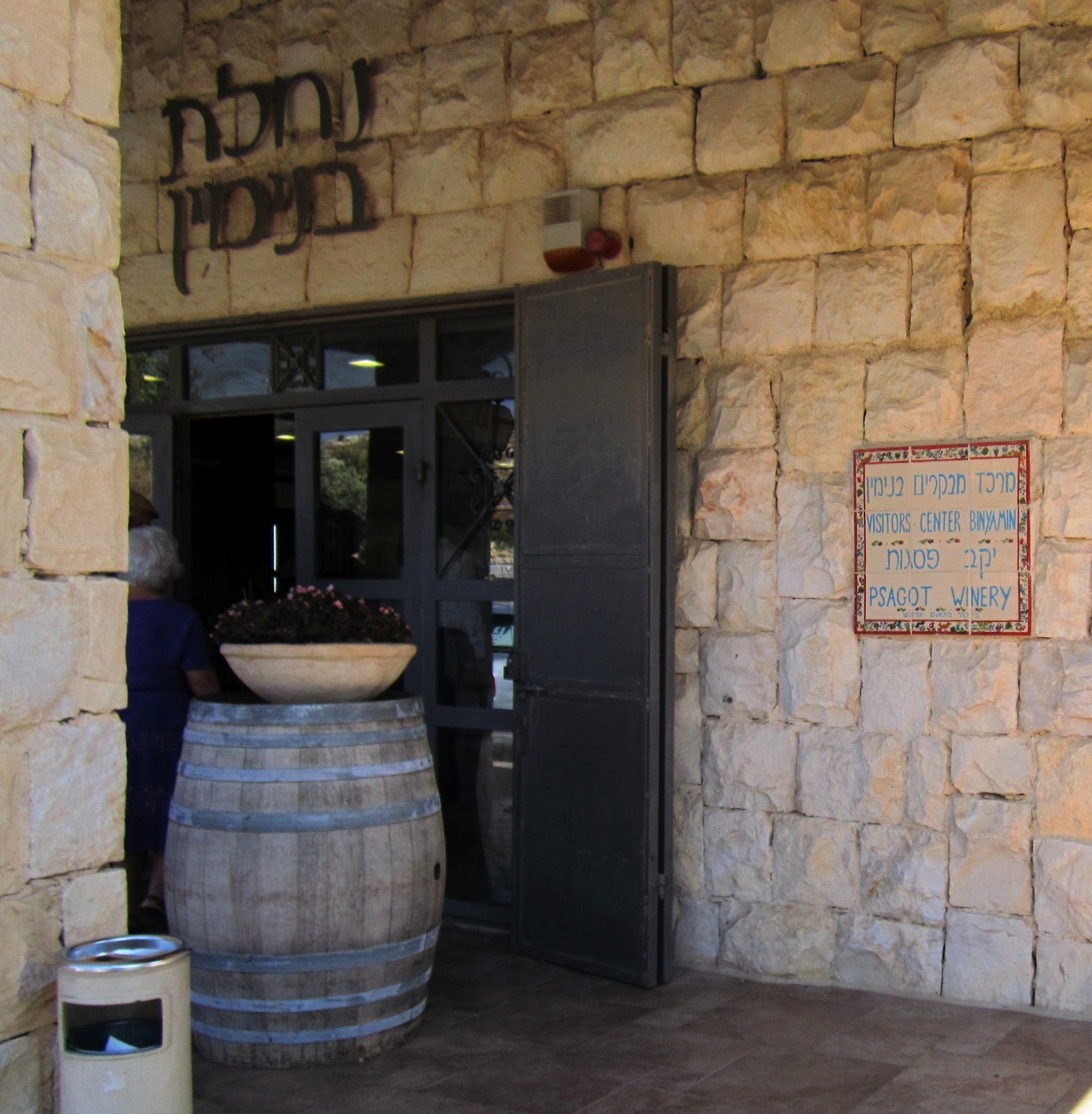
The staff was friendly and informative. The film about the winery remembered to tell us that this was Biblical territory, recently proved by an authentic coin found in an archaeological dig. Please check out the Wine Musings Blog for details and a more flattering review.
 |
| One of the friendly staff members at Psagot Winery. |
 |
| Nice, clean layout for efficiency and tasting pleasure |
 |
| Belly up to the bar, frum tasters! It was hard to get us downstairs for the movie... |
 |
| Not the best photo of the actual metal replica of the authentic coin found in the area. |
 |
| The Dearly Beloved and I spent most of our time outside, enjoying the scenery. |

We were met by a lovely young woman (who said that she was asked to speak to us because she speaks English fluently, being an Anglo olah vatika, and because she's the yishuv grandmother. Looked pretty young to us). Her name is Aviela Deitch, and if you have questions about Migron from an insider -- including how you can help -- please feel free to contact her.
 |
| Eve Harow, Aviela Deitch, and another sweet member of our tour group. |
 |
| Aviela, speaking with passion and conviction born of the knowledge that she and her community are in the right. |
 |
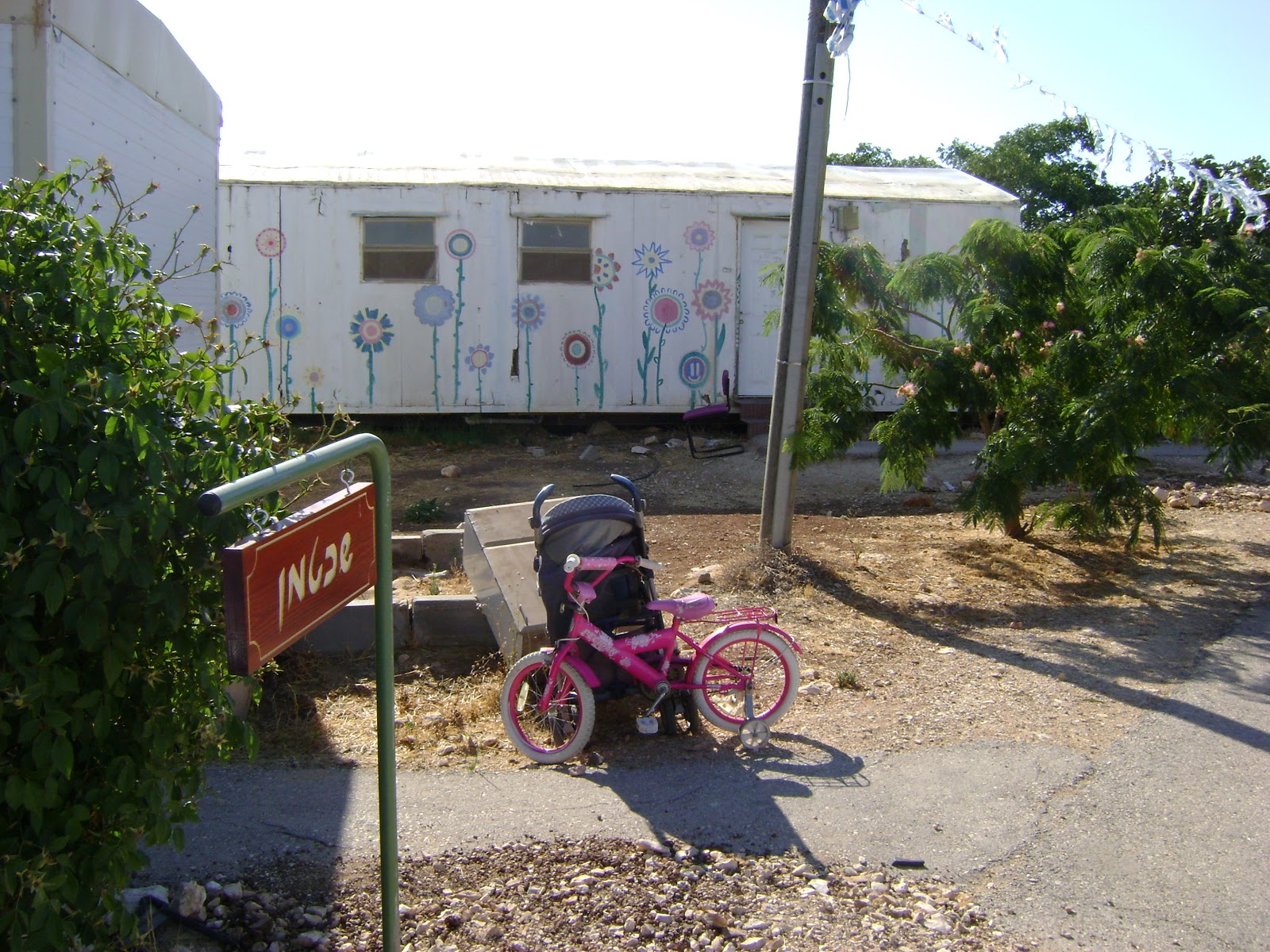
| These small caravan houses look out on our Jewish Biblical history. |
 |
| Children are the most important "crop" produced in this sweet little village. |
 |
| We had to take over a classroom, as the shul was being used for an educational program for the children. |

 |
| These are the Arab agricultural fields that Peace Now accuses the Migron Jews from stealing from the Palestinians? What were they growing? Where can you sell rocks and brush? |
 |
| More of the alleged "fields" supposedly stolen. Yeah... I can see that. NOT. The building in the background is the community mikveh. |

 |
| Sandwiched between the elegance of the Psagot Winery and an Arab-owned quarry (where rock is legitimately harvested, rather than in the fields of Migron), is the new planned refugee village for the Migron residents. |
At one time, the Israeli government supported and encouraged the settlement enterprise, as did the Magistrate's Court (which should be the only body involved in a property dispute). Migron was no exception. According to the booklet "Migron: All the Lies, All the Truth," Ariel Sharon classified Migron as a "strategic outpost" that would not be evacuated in any scenario. However, recently the Israeli government -- and especially the Supreme Court -- has seemingly turned its back on any communities that might upset their hopes for a two-state solution -- even though many Israelis and other intelligent observers now see this option as an epic fail.

Remember the beautiful bracha inadvertently given to the Jewish people by Bilaam? "How lovely are your tents, O Yaacov..." This referred to the modesty of the Jewish people who emplaced their tents so that no window or door faced the window or door of another's tent. No such consideration here. "If we need a cup of sugar," quipped Aviela," we will only have to reach out our window and take it from the table of the dwelling next door."
One of the many precious industries Migron adds to the world is a Horseback Riding Therapy Clinic, devoted to helping young people to overcome psychological and emotional challenges. One of our tour members asked Aviela what would become of the horses. Would the community be given sufficient warning to move them? "There is nowhere to move them. When you see the housing they have planned for us, you will see that there is no place for them," she responded. "What will be done with them?" we asked. Aviela answered as gently as she could: "They will have to be killed."
 |
| The sign outside the stables quotes Pirke Avot: "If I am not for myself, who will be for me? And if I am only for myself, what am I? And if not now, when?" |
Photo credit: Ruti and Avi Eastman
Tuesday, July 24, 2012
My Amazing Illegal Outpost Adventure: Ariel and Barkan
Yom shlishi, 5 Av 5772.
If you haven't read Part One of this tour, and feel the need, please click here.
If you haven't read Part One of this tour, and feel the need, please click here.

After we left Kedumim, we started driving toward Ariel. Ariel, a city of more than 17,000 residents, has been in the news a lot lately, due to a boycott of its Center for the Performing Arts by actors who -- I'm sorry to say -- didn't do their homework before jumping like lemmings off the "Israel has to be in the wrong" cliff, and because of the university there that has been trying to get status as an official university of Israel. Fierce opposition to the request has been launched by parties on the Left who assume that we Jews have no right to live in the West Bank. And so it goes...

Ariel, the capitol of the Shomron, is a lovely little city that has been in existence since 1978. I think it's important to remember, as we listen to the skewed "news" stories about the Middle East, that not all of the so-called illegal settlements are tiny groups of caravans. (Even that shouldn't be an issue, according to a correct reading of international law; but we'll get to that later.) The MSM (mainstream media) like to present these communities as if they are temporary, hastily-thrown-together encroachments on territory that rightfully belongs to Arabs. Rather, the West Bank -- which is more honestly called Yehuda and Shomron -- is filled with Arab cities and villages, and Jewish cities and villages. With lots of open spaces in between.

And for those who still persist in believing news accounts that seem to indicate that settlers are willfully putting up these "villages" without Israeli government support, remind them that even Israelis cannot cause electricity, plumbing and sewage to sprout out of the ground without a little help from their friends.
Ariel's university has, according to YNet, 13,000 students, including 5% Arab students and a large number of Ethiopian Jewish students. I am sure they are all grateful that that their degrees will be obtained by an official university -- as this status was finally obtained a few days after our tour. (We didn't have anything to do with the final outcome, other than being really happy for Ariel and all concerned.)
 |
| We're talking serious infrastructure here. |

We had lunch in the sweet little park pictured above. The park, like most of the parks we have seen in Shomron and Yehuda, reminds us that children are the most important commodity of the settlement enterprise.
 As the Dearly Beloved says, the best part of any tour is the people we meet. We were blessed to meet several lovely couples, among them the Franks, with whom we shared lunch and conversation. They are new olim, 85 and 81 years old, who live in French Hill in Jerusalem. "I just told him it was time to make aliyah," said Lore Frank. "So I came," finished Shimon Frank. Lore (pronounced "Lori") was very proud to let us know that Shimon had been here before. "He fought with the navy in the War of Independence in 1948," she told us. They inspired us in so many ways, and we hope to keep in touch.


After lunch, we packed up for the trip to Barkan, a very small yishuv, where the sweet and funny owner of the Eynavis boutique and chocolate workshop, Sharon Kahane, taught us how to make chocolate -- and insisted disarmingly that we teach her to speak English.


 |
| A pillbox guard post -- sometimes called a "fillbux" or a "pillibox" by Israelis -- is a constant reminder that the IDF must keep its eyes and ears on the areas surrounding these yishuvim at all times. |
 |
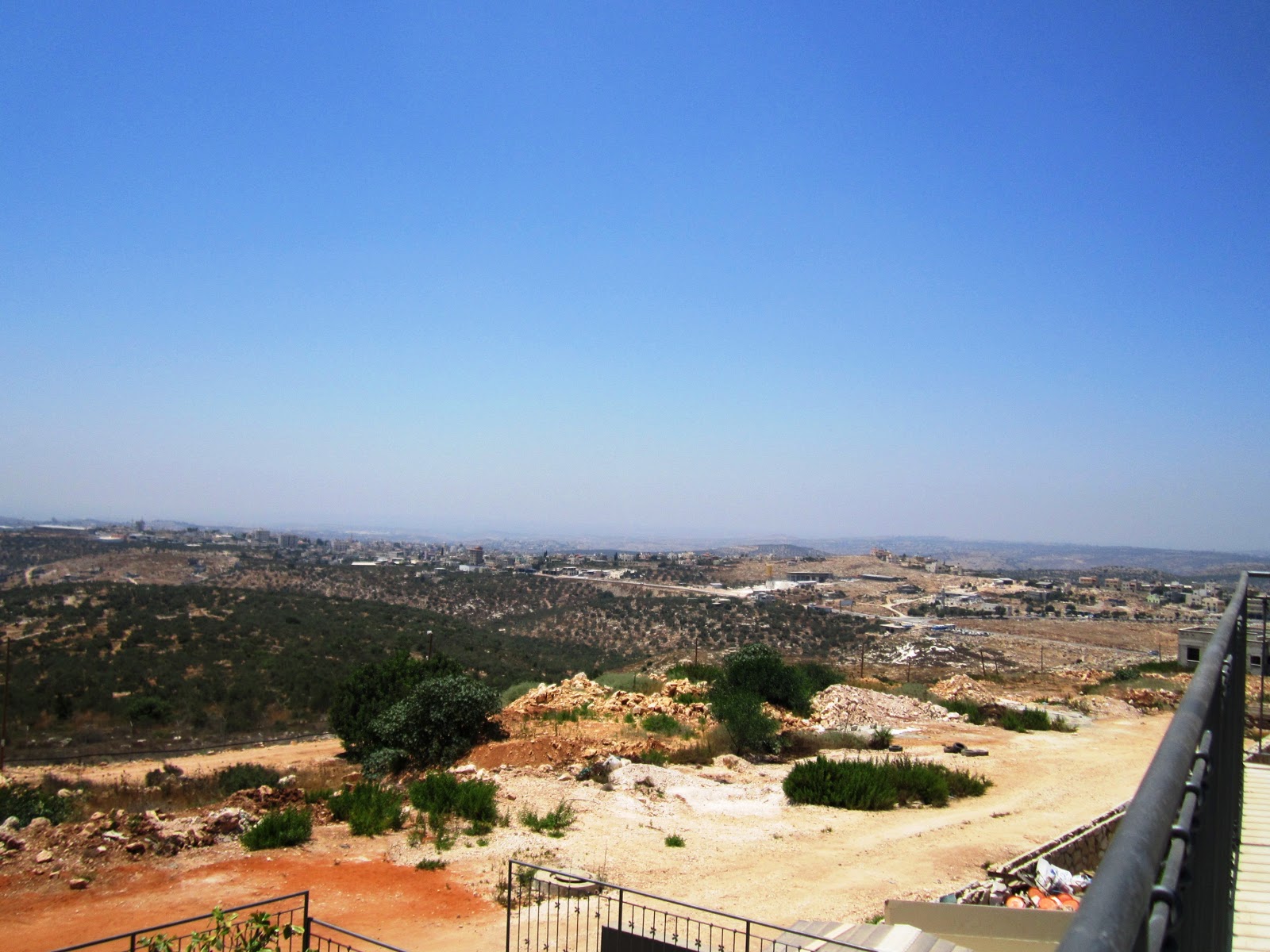
| The view of the area surrounding Eynavis |
 |
| Hard to imagine why people think there isn't room for all kinds of settlement... |
After lunch, we packed up for the trip to Barkan, a very small yishuv, where the sweet and funny owner of the Eynavis boutique and chocolate workshop, Sharon Kahane, taught us how to make chocolate -- and insisted disarmingly that we teach her to speak English.
 |
| The process is quite detailed. When she was finished, we understood why handmade chocolate isn't cheap! |


Eve Harow, our tour guide, explained to us how the international boycott of products from Yehuda and Shomron is affecting both Israelis and Palestinians -- and, in fact, Palestinians more than Israelis. While Eynavis is an exception, many companies have moved their businesses to Tel Aviv and other areas within the Green Line, to avoid the boycott. So while the Jewish businessman might be temporarily inconvenienced, his business can continue to thrive. However, if he hired Palestinian laborers, they are simply out of a job. I wonder if the organizations that work so hard to punish Israel for being Jewish to help the downtrodden actually think this through?
Stay tuned for the third and final part of our adventure: a visit to Psagot for wine, and to much-maligned Migron. The plot thickens...
Sunday, July 22, 2012
My Amazing Illegal Outpost Adventure: Kedumim
Yom rishon, 3 Av 5772.

This adventure was so full of things to learn and people worth knowing, it will take more than one post. Stick with me. This tiny country is so full of wonderful and important stories!
A week ago, the Dearly Beloved and I went on a tour of the Shomron (Samaria, aka the northern part of the "West Bank") with Eve Harow, under the auspices of the OU Center in Jerusalem. Eve is a knowledgeable and entertaining tour guide who uses the Tanach as a guidebook. It is deeply satisfying to travel the Holy Land of Israel while being shown the locations where great Biblical events actually took place.

Michael's story is nothing short of amazing. He told us that he was a secular Jew from the former Soviet Union, with no knowledge of the Torah or the Holy Temple, and with no belief in G-d.

He was invited to Kfar Chabad for Shabbat when he was a young oleh, and saw his host's children playing a card game. As he looked closer, he saw that the cards had unusual symbols on them, not the usual hearts, spades, diamonds and clubs. One picture in particular fascinated him, so he asked about it. The children didn't understand how a grown man could not know about the Holy Temple, but they patiently explained to him.


A few weeks later, he had a powerful dream about the Temple. He became obsessed with it. A master stonemason, he felt that he would not rest until he had built it, and with materials as authentic as possible.
He wanted it to be right, but he had no idea where to find answers, not yet knowing enough to go to the Mishnah for details. He stumbled upon the works of Josephus Flavius, the commentator of the period of the Roman conquest of Jerusalem and the Holy Temple. Michael read and re-read with fascination the detailed description in Josephus' writings about the Temple. With guidance from his research and the Temple Institute in Jerusalem, he painstakingly constructed a model that was so accurate that Aish HaTorah commissioned a 1,200 kilogram version that was placed on top of a roof of one of their buildings overlooking the Kotel.

The sweetest part of the story is that Michael's obsession with his dream, and with learning about and building his model of the Second Temple, caused him the begin observing Judaism. He went on to build a beautiful replica of the Mishkan as well.


 |
| Even the curtain for the front of the model of the Mishkan was woven in careful detail. |
 After this inspiring visit, we moved to the Kedem Museum, which was founded and is run by Zvi (Zvika) Slonim, winner of this year's Moskowitz Prize for Zionism. Unfortunately, the museum is going through renovations; so we were unable to learn anything about it. (A good reason for a return visit.)
To quote the Moskowitz site, "The Moskowitz Prize for Zionism was established in recognition of the people who put Zionism into action in today’s Israeli society – at times risking their own personal security, placing the collective before personal needs, and doing what it takes to ensure a strong, secure Jewish homeland."
 A seventh-generation Israeli, Zvi Slonim is a direct descendant of the Alter Rebbe of Lubavitch, and the grandson of the chief rabbi of Hevron at the time of the 1929 pogrom. He is also a criminologist, and an expert on juvenile delinquency and special education. What motivated him to leave a fulfilling career and work so tirelessly to fill the Land with Jews? He quotes Mesilat Yesharim (The Path of the Just): "What is man's obligation in this world?"
One night, he heard Egyptian president Anwar Sadat say that he would be willing to sacrifice a million soldiers for a tiny speck of the land of Israel. Hearing this impressed upon Zvi how important must be the Land to the Jews. He felt that our Torah teaches us that we must love the Land, and that we must fill it up and live in it. He hoped that he could bring a hundred Jews with him. He became one of the founders of the Gush Emunim movement, and one of the first settlers in the Shomron. It was important to him that his organization purchase every speck of land legally, without violence, without a hint of stealing the land, so that no one could question the legality of the Jewish ownership of the settlements. He proceeded to help to establish 148 settlements with a half a million people.
To be continued. Next stops: Barkan for handmade chocolate, and Ariel, home to Israel's eighth university.
Photos taken by Ruti and Avi Eastman
Subscribe to:
Posts (Atom)