Showing posts with label tolerance. Show all posts

Monday, December 19, 2011

"Cool it!"

Yom sheni, 23 Kislev 5772.

I am an Orthodox Jewess.

I use the word "Jewess" purposefully, because it is under-used and accurate.  As princess is to prince, it speaks of my unique role, which I find beautiful.  I don't want to be marginalized by being lumped in with Jews as a group.

I don't believe that I have the right, nor do I gain anything, by telling other Jews how to dress and where to sit.  (This excludes my own children, and certain young guests, who actually come to my table to hear me say "One more button, Shimon."  I kid you not.)

While I am not part of the Israeli Hareidi scene, I have respect for their culture.  I tend to dress just a little more modestly when I go into their neighborhoods, out of respect for their sensibilites.  I do not see a need to upset them.  While theirs is not my personal way of expressing my Orthodoxy, I do not find any value in offending them on their turf.

I find it offensive when I see a caption under a photo of shoppers willingly separated by a mechitza in a Hareidi store that intimates that they are extremists.  Men and women have chosen this way to express their interpretation of G-d's demand for modesty within their own community.  Having lived and visited in both the American and Israeli Hareidi communities, I know that most Hareidi women value this version of modesty as much as do the men.  And these are not oppressed women.  They are very strong proponents of their view of Orthodoxy.

That said, I am hurt and offended when non-adherents of these views are harassed, threatened, or even merely embarrassed.

Years ago, before I made aliyah, I experienced some of this maltreatment.

I boarded a bus for a neighborhood unfamiliar to me, on my way to request a blessing from a great Torah luminary.  A man in his thirties began to berate me loudly in Yiddish.  I had no clue what I had done wrong.  Eager to end this embarrassing situation, I explained to him that I could not understand what he was saying.  I tried in my meager Hebrew, and then resorted to English.  Finally, a woman a seat or two behind me explained that I was sitting too far toward the front of the bus.  As I looked around me, I acknowledged the separate nature of the bus.  I got up and sat behind the woman.  But before I left my seat, I explained to the man, in English, that his approach was terrible, and was surely more offensive to Torah than where I unintentionally sat.

I am not a woman who needs to make a point of sitting in the front of the bus to prove a point.  I have lived among normal, healthy Hareidim long enough to know that most Hareidi men don't think of woman as second-class citizens.  (You have only to be inside their homes to know this first-hand.)  So there is no reason to go all Rosa Parks.  She did have something to prove, as blacks in those days in America were indeed relegated to using separate facilities due to discrimination.

But I am highly offended when someone teaches through intimidation, rather than through patiently explaining.  Whether the young man was correct or not -- and since the bus was a public rather than private bus, and therefore he was not correct -- is beside the point.  The Torah forbids embarrassing a fellow Jew.  Had he given me the benefit of the doubt and assumed that I did not know this cultural convention, he could have said his words gently.  Or, better yet, he could have rolled his eyes to his male seatmate and endured my presence.

There is an old Japanese kōan about a couple of monks walking through the village, talking of philosophical concepts.  They approach a giant puddle in the road, before which is standing a geisha, who cannot cross without soiling her beautiful garments.  Without pausing in his dialogue, one of the monks breaks tradition, and picks up the geisha, carrying her across the puddle.  He sets her down, and continues speaking with his fellow monk.  After some time, he realizes that his companion has been silent since the puddle.  "What is going on in your mind, my friend?" he asks.

"I cannot believe that my friend and colleague broke our tradition by touching the woman," the second monk responded.

His friend looked at him, astonished.  "Oh -- are you still carrying her?"

For all of the avowed modesty of these loud, rude and sometimes violent Hareidi individuals, methinks they protest too much to be truly following the laws of modesty.

If Orthodox Jews feel a mission to bring our fellow Jews closer to our interpretation of a Torah life, we certainly do not bring them closer by berating them, by putting up offensive signs, by threatening those who do not keep whatever level of religiosity we deem appropriate.  (And, in fact, my friends in the Hareidi community also disagree with the intimidation approach.)

We are enjoined by most normal, healthy rabbis to set an example by how we live our lives.  And we still have a lot to do in the realm of exhibiting acceptable Torah behavior with our own bodies, minds and actions.  We should display the highest standards of ahavat Yisrael, honesty in business, politeness and purity of speech, among other character traits demanded by the Torah, rather than wasting our time and G-d's time by demanding that others live as we see fit.

Professor Alan Dershowitz and I have virtually nothing in common politically.  But I have to agree with a statement he made in a recent interview.  "The debates in Israel have become so extreme, with Israelis calling each other facists, and predicting that Israel will become a facist country, and will eliminate all democracy... My suggestion to Israelis is: cool it.  Calm down.  Stop calling each other names."

We will most successfully bring the harmony we seek by respecting rather than condemning each other.

Friday, April 1, 2011

Is it racism to be afraid of dying?

Yom shishi, 26 Adar bet 5771.


There has been a lot of talk among my friends lately about racism.  This was brought on, in part, by Israeli Apartheid Week, as well as by a video clip called "What Would You Do?"  The clip shows an experiment in which actors play the parts of a racist store keeper and the customer he refuses to serve.  In this case, the store keeper is an Israeli, one assumes Jewish, and the customer is a young Arab woman in a hijab.  The experiment, with hidden cameras, observes how people respond to the situation.  (Israeli Apartheid Week is just nonsense; so I won't waste your time with it here.)

Much conversation has ensued about whether or not Jews in Israel are racist toward their Arab neighbors.  The discussion has gotten heated, as one friend will post examples of how Jews in Efrat write unchallenged anti-Arab comments on the community chat list  ("Just one example: 'They can do their shopping out of Efrat. It is NOT a place for them.' No one on the list took issue with it."), while another will refute this, pointing out that there is a difference between how that same person in Efrat might think about an Israeli Arab as opposed to a Palestinian Arab -- clearly not racism. What is it, then?

I have a friend who will go anywhere, just to show the world that he can.  He has an Arab friend who lives in Ramallah.  "So, when can I come and visit you?" he asked his friend.  "It wouldn't be a good idea," his friend told him.  "My [Arab] neighbors wouldn't like it."  Why does the cautious Jew get castigated, but this kind of story never even makes the news, much less the court of world opinion?

As another friend says, "What is needed is SYMMETRY. There is no symmetry in Israel -- almost in all ways related to Arabs. You are not able to create the very same video with a Jew walking with his kippa into a shop in Ramallah or Jenin. Lets create symmetric situations, film them and then I agree to discuss about this topic."

For the record, while relations between the Jews and Arabs in the Middle East have never been totally trusting and easy, there were periods before the increased involvement of the West and the United Nations that were much better.  Not only could Arabs travel relatively freely all over Israel, shopping and dining wherever they wished (as, indeed, they still can, certainly with a greater degree of safety than a Jew can shop in Ramallah or Jenin), but a Jew could travel to Bethlehem, shopping and exchanging pleasant conversation with merchants in the Arab shuk.  Now, even the old-timers I know don't dare travel through those cities.

When I was a girl in America, one could still hitchhike to get from place to place.  One day, I got into a truck with a truck driver who forgot to keep his hands to himself.  I got out at the first opportunity, and resolved never to take rides from men again.  I didn't suddenly become sexist.  I just became cautious.  Later, when a few women passengers were reported to have done scary things (such as attacking their hosts with knives, holding them up, and so on), people stopped giving rides, period.

None of my children ever appeared on a milk carton -- if you can't remember this era in American history, ask your parents -- nor were the children of any of my friends kidnapped.  That was irrelevant.  MY kid wasn't going to be stolen.  I didn't suddenly become "transportationist."  They just weren't permitted to travel on city buses or to go anywhere alone until they grew to be husky young bruisers.

When we moved to Baltimore, we had just come from the US Army, where everyone -- regardless of race, creed or color -- is "green."  Racial intermarriage is tolerated within the military to a greater degree than in society at large, because -- with the usual exceptions -- we are all one family.  So when we moved to this East Coast city, we shocked our black neighbors by actually talking to them and smiling at them.

Later, as black high school boys turned my kids upside down to shake candy and money out of the their pockets, and routinely stole their bikes and other toys, they and we learned to be prejudiced.  But our prejudice was specific: it only included inner-city black males in packs between the ages of fourteen and twenty-five.  (Incidentally, my black neighbors who were in their fifties shared the same unfortunate prejudice.)  When we moved to Israel, we did not take this "racism" with us.  Ethiopian Jews are as beloved to us as any other Jews.
The warmth of one Ethopian soldier helped us raise Jewish lads with good attitudes.
Perhaps the most difficult inner turmoil with which I wrestle is the way I am forced to treat the Palestinians who work on my yishuv as invisible.  In America, if a workman of another race or social group worked regularly in my neighborhood, I would greet him, ask about his family, give him something to drink.  Here, I do not feel that comfort level, purely because the workers won't walk around with clear neon signs on their foreheads stating "I am just trying to make a living, and have nothing against Jews," or "I hate Jews, and can't wait for the next Intifada so I can kill off a few."

When I have a pleasant encounter with an Arab woman on a bus or in a shop, I am delighted!  But I cannot treat all of her brothers like people.  This causes me great pain.  It's just not the way I was raised, and it's not the way I want to behave.  You may call this racism, if you like to toss around emotional epithets without thinking too deeply.  I call it tragically necessary caution, and cannot wait for the day I can set it aside, and take advantage of some of those great sales in Bethlehem.

Happily, the customers we are allowed to see in the filmed experiment treat the situation in what I see as the typical Jewish manner.  They are offended at the store keeper's callousness; and customer after customer offers to pay for the young woman's coffee.

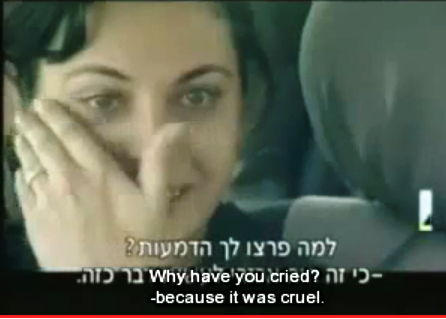
The most touching scene is at the end.  A young Jewish woman stands quietly while the store keeper loudly declares to the Arab woman that he doesn't serve her kind in his store.  At first, we are disappointed by the Jewess.  Unlike the previous customers, she doesn't speak up.  When asked, she responds, "What difference would it make what I think?"  Finally, when she gets her coffee, she responds to their questions, "You want to know what I think?  This is what I think."  And she hands her coffee to the Arab woman, and walks out.

The interviewer who set up the experiment approaches her in her car.  She is sobbing and shaking.  When he asks her why, she answers that it is because she could not believe anyone would behave in such a cruel manner toward another human being.

The Arab woman and the Jewish woman share a few warm remarks, and a gentle touch of the hands -- and we share a moment of hope.  May the day soon come when all men can treat one another as friends and brothers.

If you wish to view the video in full, you can see it here.